
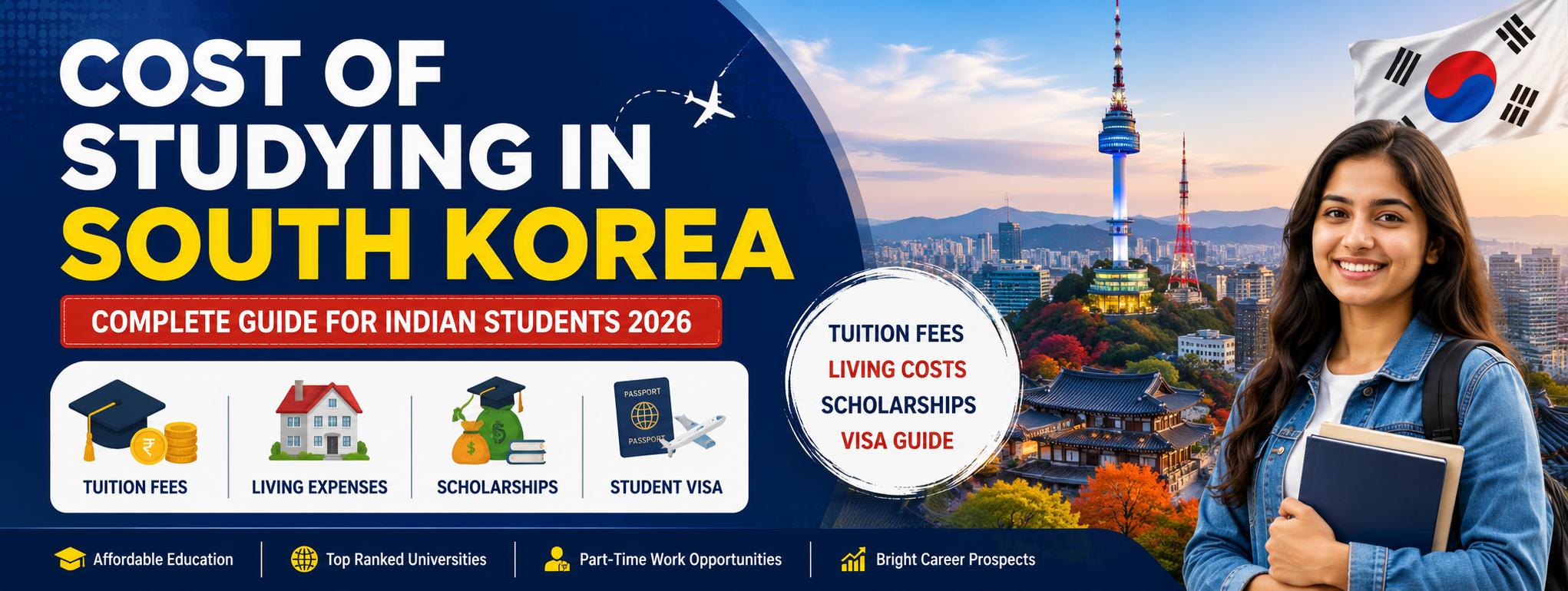
Cost of Studying in South Korea for Indian Students (2026)
South Korea has rapidly become one of the most preferred study-abroad destinations for Indian students. Known for its globally ranked universities, affordable tuition fees, cutting-edge technology, excellent research opportunities, and strong employment prospects, South Korea offers exceptional value compared to many traditional study destinations like the USA, UK, Canada, and Australia.
One of the biggest reasons students choose South Korea is that they receive a world-class education at a comparatively affordable cost. Whether you plan to pursue an undergraduate, postgraduate, MBA, engineering, IT, design, business, or Korean language program, understanding the complete cost of studying in South Korea is essential for effective financial planning.
The total cost of studying in South Korea depends on several factors, including the university, course, city of residence, accommodation type, lifestyle, and personal spending habits. On average, Indian students can expect to spend between ₹10 lakh and ₹22 lakh per year, including tuition fees and living expenses.
If you're planning your higher education journey and need expert guidance on selecting universities, scholarships, visa documentation, and application procedures, Overseas Education Lane (OEL) provides end-to-end support as a trusted South Korea education consultant for Indian students.
Why Study in South Korea?
South Korea has emerged as one of Asia's strongest education hubs. Universities such as Seoul National University, Korea University, Yonsei University, KAIST, Hanyang University, and Sungkyunkwan University consistently feature among the world's leading institutions.
Students choose South Korea because it combines academic excellence with affordability. Unlike many Western countries, tuition fees are relatively lower, while students still gain access to advanced laboratories, globally recognized degrees, internship opportunities, and a vibrant international student community.
South Korea also offers generous scholarships for international students, making higher education even more accessible. Students can work part-time during their studies, helping manage their monthly expenses while gaining valuable work experience.
For Indian students seeking a high-quality education with excellent career opportunities, South Korea provides an ideal balance between affordability and future growth.
What is the Total Cost of Studying in South Korea?
The overall cost includes much more than tuition fees. Students should budget for accommodation, food, transportation, health insurance, books, internet, entertainment, and personal expenses.
Estimated Annual Cost
| Expense | Estimated Cost (KRW) | Approximate Cost (INR) |
|---|---|---|
| Tuition Fees | 5,000,000 – 15,000,000 | ₹3–9 Lakhs |
| Accommodation | 2,500,000 – 6,500,000 | ₹1.5–4 Lakhs |
| Food | 2,000,000 – 3,600,000 | ₹1.2–2 Lakhs |
| Transportation | 500,000 – 900,000 | ₹30,000–55,000 |
| Health Insurance | 300,000 – 900,000 | ₹18,000–55,000 |
| Miscellaneous | 1,000,000 – 2,000,000 | ₹60,000–1.2 Lakhs |
Estimated Total Annual Cost: ₹10 lakh to ₹22 lakh
The exact cost varies depending on your university, city, and lifestyle.
Tuition Fees in South Korea
Tuition fees are the largest component of your study abroad budget. Fortunately, South Korea remains one of the most affordable destinations among developed countries.
Public universities generally charge lower tuition fees than private universities, although both offer excellent education standards.
Undergraduate Programs
Undergraduate tuition usually ranges between KRW 4 million and KRW 8 million per year, depending on the university and course. Programs in humanities and social sciences are generally more affordable than engineering, medicine, architecture, or design.
Students enrolling in technology or engineering disciplines should expect comparatively higher tuition due to laboratory and research facilities.
Master's Programs
Master's degrees typically cost between KRW 5 million and KRW 12 million annually.
MBA programs, AI, Data Science, Robotics, Computer Science, and Business Analytics may have higher tuition because of specialized curriculum and industry collaborations.
Many universities also provide research assistantships that help reduce tuition costs for postgraduate students.
PhD Programs
Doctoral programs generally range from KRW 4 million to KRW 10 million per year.
Research scholarships and professor-funded assistantships significantly reduce expenses for many international PhD candidates.
Tuition Fee by Course
| Course | Average Annual Tuition |
|---|---|
| Engineering | ₹5–9 Lakhs |
| Computer Science | ₹5–9 Lakhs |
| Business | ₹4–8 Lakhs |
| MBA | ₹8–15 Lakhs |
| Arts & Humanities | ₹3–6 Lakhs |
| Korean Language | ₹2–4 Lakhs |
Living Expenses in South KoreaApart from tuition fees, students must budget carefully for daily living expenses. South Korea is considered moderately expensive, but students who plan wisely can comfortably manage their finances. The monthly cost of living typically ranges between KRW 800,000 and KRW 1.5 million, depending on the city and lifestyle.
Students living in Seoul generally spend more than those studying in cities like Daejeon, Daegu, Gwangju, Busan, or Incheon. Accommodation Costs in South KoreaAccommodation is the second-largest expense after tuition. Students usually choose among university dormitories, shared apartments, studios, or homestays. University DormitoriesDormitories are the most affordable and convenient option for international students. Monthly Cost:
Benefits include furnished rooms, internet, security, laundry facilities, and proximity to classrooms. Shared ApartmentsMany international students prefer sharing apartments with friends to reduce expenses. Monthly Cost:
Shared apartments provide greater privacy and flexibility while lowering rental costs. Studio ApartmentsStudents seeking complete independence often rent studio apartments. Monthly Cost:
These apartments offer private kitchens and bathrooms but come with higher utility expenses. Food ExpensesSouth Korea offers affordable dining options for students. University cafeterias provide nutritious meals at economical prices, making them the preferred choice for international students. Monthly food expenses generally range from: KRW 250,000–450,000
Students who cook at home can reduce costs significantly by purchasing groceries from local supermarkets. Transportation CostsSouth Korea's public transportation system is among the world's best. Students frequently use subways, buses, and local trains, all of which are safe, efficient, and budget-friendly. Average monthly transportation cost: KRW 50,000–100,000
Student transportation cards further reduce commuting expenses. Health InsuranceHealth insurance is mandatory for international students in South Korea. It provides coverage for doctor consultations, hospitalization, emergency care, and various medical treatments. Students generally spend between: KRW 25,000–75,000 per month
Having proper insurance ensures financial protection against unexpected medical expenses. Miscellaneous ExpensesApart from tuition and living costs, students should also budget for books, internet, mobile plans, clothing, entertainment, personal shopping, and weekend travel. These expenses typically range between: KRW 100,000–250,000 per month
Careful budgeting helps students maintain a comfortable lifestyle while avoiding unnecessary spending. Monthly Budget Summary
Scholarships to Reduce the Cost of Studying in South KoreaOne of the biggest advantages of choosing South Korea for higher education is the wide range of scholarships available to international students. These scholarships can significantly reduce tuition fees and, in many cases, even cover living expenses, airfare, and health insurance. For Indian students, scholarships make studying in South Korea much more affordable and accessible. Many South Korean universities offer merit-based scholarships that reward students with strong academic records. Depending on your grades and university policies, you may receive a tuition fee waiver ranging from 30% to 100%. Some universities also provide additional scholarships after the first semester based on academic performance. The Global Korea Scholarship (GKS), funded by the South Korean government, is one of the most prestigious scholarship programs for international students. It typically covers tuition fees, monthly living expenses, airfare, settlement allowance, medical insurance, and Korean language training. Receiving the GKS can significantly reduce the overall cost of studying in South Korea. Several universities also offer research assistantships and teaching assistantships to postgraduate and doctoral students. These opportunities not only help students financially but also provide valuable academic and professional experience. If you are unsure about which scholarships you qualify for or how to prepare a strong application, an experienced South Korea education consultant like Overseas Education Lane (OEL) can guide you through the scholarship application process and improve your chances of receiving financial aid. South Korea Student Visa Cost for Indian StudentsBefore beginning your academic journey, you must obtain a South Korean student visa. Most degree-seeking students apply for the D-2 Student Visa, while Korean language students usually apply for the D-4 Visa. Apart from the visa application fee, students should also consider expenses such as document verification, passport renewal (if required), educational certificate attestation, translation services (where applicable), travel insurance, and biometric requirements. On average, Indian students should budget ₹15,000 to ₹35,000 for the complete visa application and documentation process, excluding airfare.
Since visa policies and documentation requirements may change, students should always verify the latest requirements before applying. OEL assists students throughout the visa process by ensuring all documents are accurate and submitted correctly, reducing the risk of delays or rejections. Airfare and Pre-Departure ExpensesMany students focus only on tuition fees and living costs, but pre-departure expenses are equally important when planning a study abroad budget. These expenses typically include:
Students should generally allocate ₹80,000 to ₹2,00,000 for pre-departure and travel-related expenses, depending on flight prices and personal requirements. Hidden Costs Students Often IgnoreWhile tuition and accommodation are the major expenses, several smaller costs are often overlooked during financial planning. Some common hidden expenses include:
Planning for these additional expenses helps students avoid financial stress during their studies. Can Indian Students Work Part-Time in South Korea?Yes. International students are allowed to work part-time while studying in South Korea, subject to visa regulations and university approval. Part-time jobs are a great way to earn extra income, gain international work experience, improve communication skills, and become more financially independent. Common part-time jobs include:
Depending on the type of work, location, and language proficiency, students can earn approximately KRW 900,000 to KRW 1,500,000 per month, helping them cover a significant portion of their monthly living expenses.
However, students should prioritize academics and ensure that their work hours comply with South Korean immigration regulations. Tips to Reduce the Cost of Studying in South KoreaManaging expenses wisely can make your study abroad journey more affordable and stress-free. Here are some practical ways to save money:
Following these strategies can help you significantly reduce your overall cost of studying in South Korea. Why Choose Overseas Education Lane (OEL) for South Korea Admissions?Choosing the right education consultant is just as important as choosing the right university. A reliable consultant simplifies the admission process, reduces errors, and helps students make informed decisions. At Overseas Education Lane (OEL), we provide comprehensive guidance for students aspiring to study in South Korea. Our services include:
With years of experience in international education consulting, OEL helps Indian students navigate every step of the admission process with confidence.
Whether you are planning to pursue a bachelor's degree, master's program, MBA, engineering, or Korean language course, our expert counsellors are here to help you achieve your study abroad goals. Frequently Asked Questions (FAQs)1. What is the average cost of studying in South Korea for Indian students?The total annual cost, including tuition fees and living expenses, typically ranges between ₹10 lakh and ₹22 lakh, depending on the university, course, city, and lifestyle. 2. Is South Korea cheaper than the USA or the UK?Yes. In most cases, South Korea offers lower tuition fees and more affordable living expenses than the USA, UK, Canada, or Australia, making it an attractive destination for international students. 3. Can I study in South Korea without IELTS?Yes. Many South Korean universities accept alternative proof of English proficiency or conduct their own language assessments. Some programs may still require IELTS, TOEFL, or equivalent scores depending on the course and institution. 4. Are scholarships available for Indian students?Yes. Indian students can apply for university-specific scholarships, merit-based tuition waivers, and the Global Korea Scholarship (GKS), among other funding opportunities. 5. Can international students work while studying in South Korea?Yes. International students can work part-time, subject to visa conditions and university regulations, allowing them to earn additional income and gain work experience. 6. Which city is the most affordable for students in South Korea?Cities such as Daejeon, Daegu, Gwangju, and Busan are generally more affordable than Seoul in terms of accommodation and daily living expenses. 7. Is health insurance mandatory?Yes. International students are required to have health insurance during their stay in South Korea. 8. How much money should I show for a South Korean student visa?The financial proof requirements vary depending on the university and visa category. Students should check the latest guidelines before applying. 9. What are the most popular courses in South Korea?Engineering, Artificial Intelligence, Computer Science, Business Management, Data Science, Biotechnology, Design, Media Studies, and Korean Language programs are among the most sought-after courses. 10. Why should I choose OEL for studying in South Korea?
OEL offers end-to-end support, including university selection, application assistance, scholarship guidance, visa processing, and pre-departure counselling, making the study abroad journey smoother and more efficient. South Korea has established itself as one of the best destinations for Indian students seeking high-quality education at a reasonable cost. With globally recognized universities, excellent research opportunities, generous scholarships, and strong career prospects, it offers exceptional value for students planning to study abroad. Understanding the complete cost of studying in South Korea—including tuition fees, accommodation, living expenses, visa costs, and other essential expenses—allows students to make informed financial decisions and prepare effectively for their academic journey. If you are looking for expert guidance, Overseas Education Lane (OEL) can help you every step of the way—from selecting the right university and applying for scholarships to securing your student visa and preparing for life in South Korea.
Take the first step toward your international education journey by connecting with OEL today and turn your dream of studying in South Korea into reality. |
Other Links
Top Destinations
Our Services
Contact Us
-
 Overseas Education Lane
-
 +91 892 992 2525
-
 [email protected]
-
[email protected]