
Introduction
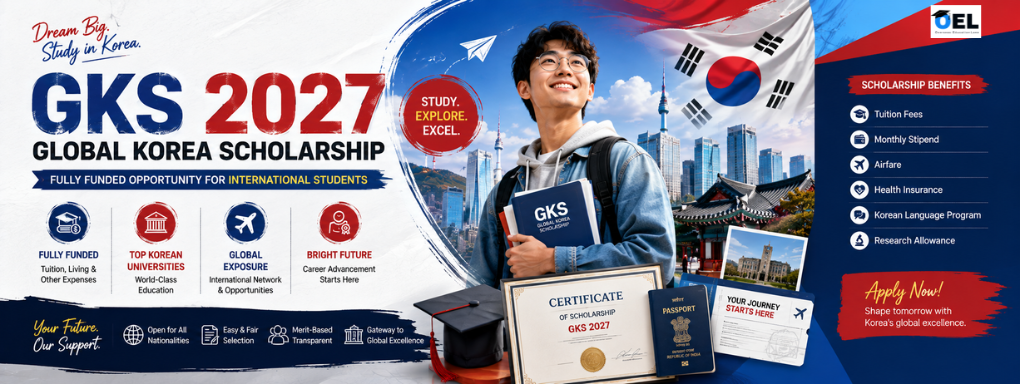
If you are planning to study in South Korea in 2027, the Global Korea Scholarship (GKS) is one of the most important scholarship opportunities you should explore. Funded by the Korean government and administered through the National Institute for International Education (NIIED), GKS supports talented international students who want to pursue higher education at Korean universities.The scholarship can provide financial support towards major study-related expenses, including tuition, airfare, Korean language training and study allowances. For Indian students planning to pursue a Bachelor's, Master's or Doctoral degree in South Korea, GKS can significantly reduce the overall cost of studying abroad.
In this comprehensive GKS 2027 Guide, we will cover GKS eligibility, scholarship benefits, application process, Embassy Track vs University Track, required documents, academic requirements, language requirements and important preparation tips.
Important: The official GKS 2027 application guidelines have not yet been released. Therefore, exact deadlines, quotas, participating universities and final eligibility criteria should be confirmed once NIIED publishes the official 2027 announcement. The latest official information currently available is for the 2026 cycle.
What Is the Global Korea Scholarship (GKS)?
The Global Korea Scholarship, commonly known as GKS, is a Korean government scholarship program designed to invite outstanding international students to South Korea and promote international educational exchange.
The scholarship supports international students pursuing degree-level education at designated Korean universities and offers opportunities across a wide range of academic disciplines.
According to the current official Study in Korea information, the GKS degree program combines Korean language training with degree study and provides benefits such as airfare, language training costs, tuition and study allowances.
For students looking for a study in South Korea with scholarship opportunity, GKS can therefore offer much more than a simple tuition waiver.
Why Is GKS Popular Among International Students?
South Korea has become an increasingly popular destination for international students because of its globally recognized universities, technology-driven economy, research opportunities and growing number of English-taught programs.
However, tuition fees, accommodation and other living expenses can still make studying abroad financially challenging.
This is where the Global Korea Scholarship for international students becomes particularly valuable. Selected students can receive government-funded financial support covering several important areas of their academic journey.
GKS can also provide students with the opportunity to experience Korean language and culture while studying at a designated Korean university.
Students interested in fields such as engineering, technology, business, artificial intelligence, natural sciences, humanities and social sciences can explore various academic pathways through the scholarship.
GKS 2027 Eligibility Criteria
The exact GKS 2027 eligibility criteria will be confirmed only after NIIED releases the official 2027 guidelines.
However, the current official information provides an indication of the general eligibility framework.
Applicants and both of their parents must generally hold non-Korean citizenship. Undergraduate applicants must satisfy the applicable age and educational requirements, while graduate applicants must meet the relevant degree requirements for Master's or Doctoral study.
The current general information also specifies an academic performance requirement of 80% or higher cumulative GPA in the most recent educational program for undergraduate applicants.
For graduate applicants:
- Master's applicants generally need a Bachelor's degree.
- Doctoral applicants generally need a Master's degree.
- Age and academic requirements may vary by scholarship cycle.
- Final eligibility must be checked against the official GKS 2027 guidelines.
Indian students should begin preparing their academic records and supporting documents now rather than waiting until the official application period begins.
GKS Undergraduate Scholarship
The GKS Undergraduate Scholarship, also known as GKS-U, is designed for eligible international students who want to pursue associate or Bachelor's degree programs in South Korea.
The current GKS framework provides undergraduate opportunities through designated Korean universities and includes general academic fields as well as specialized opportunities in science and engineering.
The scholarship structure combines Korean language training with degree study, although the exact duration can depend on the degree pathway and applicable program.
For students planning to study in South Korea after Class 12, GKS can be an important scholarship pathway to explore.
GKS Graduate Scholarship
The GKS Graduate Scholarship is designed for international students interested in pursuing Master's and Doctoral programs in South Korea.
Students can apply to designated universities and departments across a wide range of academic disciplines.
For reference, the 2026 GKS-G program planned to invite 2,000 international students for graduate degrees through the Embassy Track and University Track. However, this number is specific to the 2026 cycle and should not be treated as the confirmed GKS 2027 quota.
The participating universities and departments can change between scholarship cycles, so students should review the official 2027 university list once it is released.
GKS Scholarship Benefits 2027
One of the biggest reasons students search for a GKS fully funded scholarship is the range of financial support offered through the program.
The current official Study in Korea information lists benefits including:
- Airfare
- Korean language training costs
- Tuition
- Study allowances
However, the exact amount of allowances, airfare conditions, tuition coverage, duration and other benefits will depend on the official scholarship guidelines applicable to the 2027 cycle.
Students should therefore avoid relying on fixed figures published on unofficial websites or social media until the official GKS 2027 guidelines are released.
GKS Embassy Track vs University Track
Understanding the difference between the GKS Embassy Track and University Track is an important part of preparing your application.
Embassy Track
Under the Embassy Track, students apply through the Korean diplomatic mission in their country of citizenship.
The embassy conducts the initial stage of selection before shortlisted applications move through the subsequent stages of the GKS selection process.
University Track
Under the University Track, applicants submit their applications directly to a designated Korean university participating in GKS.
The university conducts its part of the selection process before candidates proceed through the remaining stages.
The choice of track can affect the universities available to you and the way your application needs to be submitted.
GKS 2027 Application Timeline
The official GKS 2027 application deadline has not yet been announced.
However, the current GKS schedule can help students understand when preparation should begin.
For undergraduate applicants, the current Study in Korea information indicates an announcement around September, with applications generally taking place around September–October and final results later in the year.
Graduate GKS applications follow a different annual schedule, with the 2026 GKS-G announcement released in February.
These dates should not be considered confirmed GKS 2027 deadlines.
Students should use them only as a preparation reference and monitor the official Study in Korea announcements for the final dates.
Documents Required for GKS 2027
The exact GKS 2027 document requirements will be provided in the official application guidelines.
However, students should begin preparing their documents well in advance because some documents may require verification, translation, authentication or certification.
Depending on the program and application track, applicants may need:
- - Academic certificates
- - Academic transcripts
- - Proof of citizenship
- - Family relationship documents
- - Recommendation letters
- - Personal statement
- - Study plan
- - Language proficiency documents
- - Passport or identification documents
- - Other supporting documents
The exact requirements can change between scholarship cycles, so applicants should always follow the official instructions for GKS 2027.
Is IELTS or TOPIK Required for GKS?
One of the most common questions students have is whether IELTS or TOPIK is mandatory for GKS.
The answer depends on the scholarship program, university, department and academic pathway.
GKS includes Korean language training within its degree scholarship structure, while language requirements can vary depending on the university and program.
Some graduate programs may be primarily taught in English, while students applying to Korean-taught programs may need to demonstrate an appropriate level of Korean proficiency.
Therefore, students should not assume that IELTS or TOPIK is automatically compulsory for every GKS applicant. The language requirements of the chosen university and program should be checked alongside the official GKS guidelines.
How to Choose a University for GKS?
Choosing the right university is one of the most important parts of a successful GKS application.
Instead of selecting a university only because it is famous, students should consider:
- - Academic background
- - Intended major
- - Research interests
- - Career goals
- - Language requirements
- - Available departments
- - GKS track eligibility
The official GKS program includes designated universities across South Korea, covering disciplines such as humanities, social sciences, natural sciences, arts, engineering and other specialized fields.
Because the participating university and department lists can change between cycles, students preparing for GKS 2027 should wait for the official information before finalizing their university choices.
How to Apply for GKS 2027?
The GKS 2027 application process begins with understanding your eligibility and deciding whether you are applying for an undergraduate or graduate program.
The general preparation process includes:
Step 1: Check Your Eligibility
Review your academic qualifications, citizenship requirements and other applicable eligibility conditions.
Step 2: Select Your Academic Level
Determine whether you are applying for an undergraduate, Master's or Doctoral program.
Step 3: Choose the Application Track
Decide whether the Embassy Track or University Track is appropriate for your application.
Step 4: Research Universities and Programs
Shortlist universities and departments that match your academic background and career objectives.
Step 5: Prepare Your Documents
Collect transcripts, certificates, recommendation letters, personal statements, study plans and other required documents.
Step 6: Prepare Your Application
Your application should clearly connect your academic background, chosen field of study, interest in South Korea and long-term career goals.
Step 7: Submit According to Official Instructions
Embassy Track applicants should follow the instructions issued by the relevant Korean embassy, while University Track applicants should follow the designated university's submission process.
Other Links
Top Destinations
Our Services
Contact Us
-
 Overseas Education Lane
-
 +91 892 992 2525
-
 [email protected]
-
[email protected]