
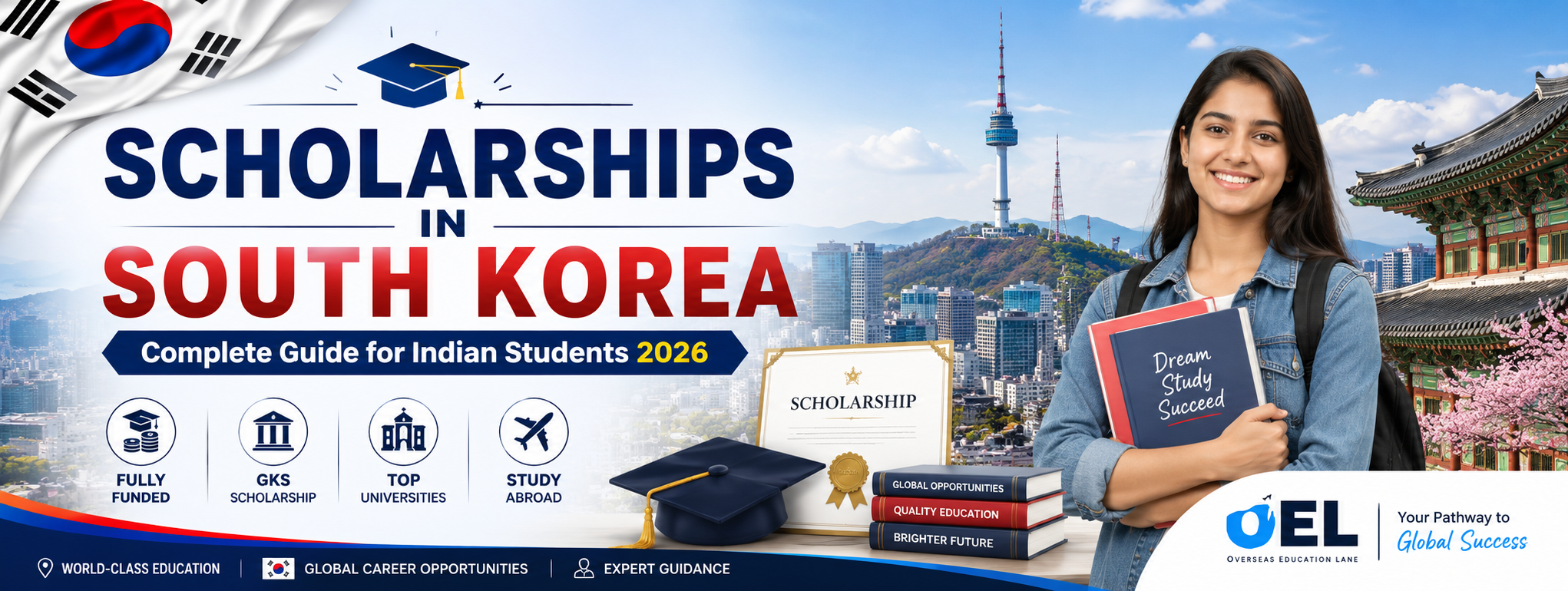
Studying abroad is a dream for thousands of Indian students, but tuition fees and living expenses often become major concerns. Fortunately, scholarships in South Korea have made quality international education affordable for deserving students. South Korea has emerged as one of the most preferred study destinations in Asia due to its globally ranked universities, advanced technology, excellent research facilities, and strong career opportunities.
Every year, the South Korean government, universities, and private organizations offer numerous scholarships for international students. Whether you are planning to pursue a Bachelor's degree, Master's program, PhD, or research course, there are multiple funding options available that can significantly reduce or completely cover your education expenses.
One of the most prestigious scholarships is the Global Korea Scholarship (GKS), formerly known as the Korean Government Scholarship Program (KGSP). Along with GKS, universities such as Seoul National University, KAIST, Yonsei University, Korea University, Hanyang University, and many others provide generous tuition waivers and merit-based scholarships for outstanding international students.
If you are an Indian student planning to study in South Korea, understanding different scholarship opportunities, eligibility criteria, application process, and deadlines can help you maximize your chances of receiving financial assistance.
At Overseas Education Lane (OEL), our experienced South Korea education counsellors guide students through university selection, scholarship applications, visa assistance, and admission procedures, making your dream of studying in South Korea a reality.
Why Study in South Korea with Scholarships?
South Korea has transformed into one of the world's leading education hubs. With world-class universities, cutting-edge research infrastructure, and strong government support for international students, studying in Korea has become more affordable than ever.
Receiving a scholarship not only reduces your financial burden but also allows you to focus on academics, research, internships, and cultural experiences without worrying about tuition fees.
Some major benefits include:
- - Tuition fee waiver up to 100%
- - Monthly living allowance
- - Free accommodation (in many universities)
- - Airfare support
- - Medical insurance
- - Research grants
- - Korean language training
- - Graduation incentives
- - Better employment opportunities
For Indian students, scholarships can reduce the total cost of studying in South Korea by several lakhs of rupees, making higher education much more accessible.
Types of Scholarships in South Korea
International students can apply for various scholarship categories depending on their academic performance, financial background, research interests, and university admission.
1. Government Scholarships
The South Korean government provides fully funded scholarships to attract talented international students from around the world.
Government scholarships usually cover:
- - Full tuition fees
- -Monthly stipend
- - Round-trip airfare
- - Settlement allowance
- - Medical insurance
- - Korean language training
- - Research support
- - Thesis printing expenses
- - Graduation grant
The most popular government scholarship is the Global Korea Scholarship (GKS)
Global Korea Scholarship (GKS)
The Global Korea Scholarship (GKS) is one of the most competitive and prestigious scholarship programs offered by the South Korean government through the National Institute for International Education (NIIED).
Thousands of students from over 150 countries apply every year, making it one of the best opportunities to pursue higher education in South Korea without financial stress.
Benefits of GKS Scholarship - Students selected under the GKS program receive comprehensive financial support, including:
Full Tuition Fee Coverage - Students do not need to pay university tuition fees throughout the duration of the degree program.
Monthly Living Allowance - A generous monthly stipend helps cover accommodation, food, transportation, and daily living expenses.
Airfare - The scholarship includes economy-class round-trip flight tickets between the student's home country and South Korea.
Korean Language Training - Students receive one year of Korean language education before starting their academic program if required.
Medical Insurance - Health insurance coverage is provided throughout the scholarship period.
Research Support - Graduate students may receive additional research grants depending on their academic requirements.
Thesis Printing Grant - Students completing research degrees receive financial assistance for thesis preparation and printing.
Graduation Award - Successful graduates receive an additional completion grant.
Who Can Apply for GKS?
The scholarship is available for
- - Undergraduate students
- - Master's applicants
- - PhD candidates
- - Research scholars
Applicants must generally:
- - Hold the required previous qualification.
- - Meet the age requirements specified in the annual guidelines.
- - Maintain excellent academic performance.
- - Be physically and mentally fit.
- - Satisfy nationality and eligibility requirements set by the program.
University Scholarships in South Korea
Apart from government-funded scholarships, almost every leading Korean university offers scholarships to international students.
These scholarships are based on:
- - Academic excellence
- - English language proficiency
- - TOPIK (Korean language proficiency)
- - Research achievements
- - Entrance examination performance
- - Financial need (at some institutions)
Many universities automatically consider students for scholarships during the admission process, eliminating the need for a separate application.
Merit-Based Scholarships
Merit scholarships reward students who have demonstrated outstanding academic performance.
Students with:
- - High CGPA
- - Excellent school grades
- - Strong entrance scores
- - Impressive extracurricular achievements
often receive tuition fee reductions ranging from 30% to 100%.
Many universities also continue these scholarships every semester if students maintain the required GPA.
Research Scholarships
Graduate students involved in research projects may receive additional funding from professors or university laboratories.
Research scholarships generally include:
- - Monthly salary
- - Tuition waiver
- - Laboratory funding
- - Research expenses
- Conference participation support
These opportunities are especially common in engineering, artificial intelligence, biotechnology, computer science, robotics, and semiconductor research.
Korean Language Scholarships
Students who demonstrate proficiency in the Korean language often receive additional financial benefits.
Universities encourage international students to learn Korean because it improves academic success and employment opportunities after graduation.
Students with higher TOPIK levels may receive:
- - Additional tuition discounts
- - Monthly incentives
- - Scholarship upgrades
- - Special academic benefits
Sports, Arts & Talent Scholarships
Several universities also recognize achievements beyond academics.
Students excelling in:
- - Music
- - Dance
- - Fine Arts
- - Sports
- - Performing Arts
- - International competitions
may qualify for special talent scholarships.
These scholarships vary by institution and are designed to support exceptional abilities while encouraging cultural diversity on campus.
Private and Foundation Scholarships
In addition to government and university scholarships, many Korean foundations, corporations, and charitable organizations offer financial aid to international students.
These scholarships may support:
- - STEM education
- - Business programs
- - Social sciences
- - Public policy
- - Environmental studies
- - Cultural exchange initiatives
Private scholarships often provide tuition assistance, living stipends, research grants, or project funding, making them an excellent option for students who may not receive government scholarships.
Why Choose Overseas Education Lane (OEL) for Scholarship Guidance?
Applying for scholarships can be competitive and requires careful planning, accurate documentation, and a strong application strategy. At Overseas Education Lane (OEL), our experienced South Korea education counsellors help students identify the right scholarship opportunities based on their academic profile and career goals.
Our services include:
- Personalized university and scholarship shortlisting
- Guidance for Global Korea Scholarship (GKS) applications
- SOP and LOR review
- Admission application support
- Student visa assistance
- Pre-departure guidance
- Accommodation and travel support
Whether you're looking for a fully funded scholarship or a merit-based tuition waiver, OEL supports you at every stage of your journey to study in South Korea.
Eligibility Criteria for Scholarships in South Korea
While every scholarship has its own specific requirements, there are certain eligibility criteria that most South Korean universities and scholarship providers expect applicants to meet. Understanding these requirements in advance can help you prepare a stronger application and improve your chances of selection.
Excellent Academic Performance
Academic excellence is one of the most important factors considered by scholarship committees. Most universities evaluate your previous academic records, cumulative GPA, percentage, class rank, and overall consistency.
Students with high grades not only have better chances of admission but are also more likely to receive partial or fully funded scholarships.
For competitive scholarships like the Global Korea Scholarship (GKS), maintaining a strong academic record is highly recommended.
Educational Qualification
Applicants must have successfully completed the required previous level of education before applying.
For example:
- Bachelor's degree applicants should have completed Class 12.
- Master's applicants should hold a recognized bachelor's degree.
- PhD applicants must possess a relevant master's degree.
The qualification should be recognized by both the university and the scholarship provider.
English or Korean Language Proficiency
Many South Korean universities offer programs in English, while others are taught in Korean.
Applicants may be required to submit English language proficiency test scores such as IELTS, TOEFL, or equivalent if the course is taught in English.
Students who have a TOPIK (Test of Proficiency in Korean) certificate often receive additional scholarship benefits and may have a competitive advantage during admissions.
Good Health
International students are generally expected to be physically and mentally fit to pursue full-time education in South Korea.
Some scholarship programs may require medical certificates before final admission or visa processing.
Strong Personal Statement
Your Statement of Purpose (SOP) is often one of the deciding factors in scholarship selection.
A well-written SOP should explain:
- - Why you want to study in South Korea
- - Your academic achievements
- - Career goals
- - Research interests
- - Why you deserve financial assistance
- - How the scholarship will help you contribute to society
An authentic, personalized, and well-structured SOP significantly improves your chances of receiving a scholarship.
Recommendation Letters
Most scholarship applications require recommendation letters from teachers, professors, or employers.
A strong recommendation highlights your:
- - Academic performance
- - Leadership skills
- - Research ability
- - Character
- - Future potential
Universities generally prefer recommendations from individuals who know your academic or professional work well.
Documents Required for South Korea Scholarships
Preparing documents well in advance can make the application process smoother. While requirements vary depending on the scholarship and university, the following documents are commonly requested:
- - Completed scholarship application form
- - Valid passport
- - Passport-size photographs
- - Academic transcripts and mark sheets
- - Degree or passing certificates
- - Statement of Purpose (SOP)
- - Letters of Recommendation (LORs)
- - Updated CV or Resume
- - English language proficiency score (IELTS/TOEFL), if applicable
- - TOPIK certificate, if available
- - Research proposal (for Master's and PhD applicants)
- - Medical certificate (if required)
- - Income or financial documents (for need-based scholarships)
Ensure that all documents are accurate, translated (if necessary), and submitted before the application deadline.
Step-by-Step Application Process for Scholarships in South Korea
Applying for scholarships requires careful planning. Following a structured approach can improve your chances of success.
Step 1: Research Universities and Scholarships
Start by identifying universities that offer your preferred course and check the scholarships available for international students.
Compare factors such as:
- - Tuition fees
- - Scholarship coverage
- - Eligibility requirements
- - Ranking
- - Course curriculum
- - Career opportunities
Step 2: Check Eligibility
Read the scholarship guidelines carefully and ensure that you meet all academic, language, and document requirements before applying.
Step 3: Prepare Documents
Collect all required documents and review them for accuracy. Missing or incorrect documents are among the most common reasons for application rejection.
Step 4: Submit University Application
Apply for admission to your chosen university within the specified deadline.
Some universities automatically consider international applicants for scholarships, while others require a separate scholarship application.
Step 5: Apply for Scholarships
Complete the scholarship application form and upload all required documents.
Double-check every detail before submission.
Step 6: Attend Interview (If Required)
Certain scholarship programs may conduct interviews to assess your motivation, communication skills, and future goals.
Prepare by reviewing your SOP, academic background, and reasons for choosing South Korea.
Step 7: Receive Scholarship Offer
If selected, you will receive an official scholarship offer along with your admission letter.
Follow the instructions provided by the university to accept the scholarship.
Step 8: Apply for Student Visa
Once your admission and scholarship are confirmed, begin the South Korea student visa process by submitting the required documents to the appropriate authorities.
Top Universities in South Korea Offering Scholarships
Many leading universities provide generous scholarships to international students based on academic performance, research potential, and leadership qualities.
Some of the best universities include:
- - Seoul National University
- - KAIST (Korea Advanced Institute of Science and Technology)
- - Yonsei University
- - Korea University
- - Hanyang University
- - Sungkyunkwan University
- - Kyung Hee University
- - Ewha Womans University
- - Pusan National University
- - Chung-Ang University
- - Dongguk University
- - Inha University
- - Ajou University
- - Ulsan National Institute of Science and Technology (UNIST)
- - Gwangju Institute of Science and Technology (GIST)
These institutions offer various scholarships ranging from partial tuition waivers to fully funded programs.
Tips to Increase Your Chances of Winning a Scholarship
Competition for scholarships in South Korea is high, but careful preparation can significantly improve your chances.
Maintain Excellent Academic Scores
Consistent academic performance remains one of the strongest selection criteria.
Write a Powerful SOP
Avoid generic statements. Explain your goals, achievements, and how studying in South Korea aligns with your future plans.
Build a Strong Profile
Participate in internships, research projects, volunteer work, competitions, and leadership activities to strengthen your application.
Improve English or Korean Skills
Higher language proficiency demonstrates your ability to succeed academically and can make your application more competitive.
Apply Early
Many scholarships operate on a first-review basis. Applying before the deadline gives your application more time for evaluation and reduces the risk of technical issues during submission.
Choose the Right Scholarship
Instead of applying randomly, target scholarships that match your academic profile, course, and career aspirations.
Common Mistakes to Avoid
Many students lose scholarship opportunities due to avoidable errors. Be mindful of the following:
- - Submitting incomplete applications
- - Ignoring eligibility criteria
- - Missing application deadlines
- - Uploading incorrect or unclear documents
- - Writing a weak or copied SOP
- - Providing inaccurate information
- - Applying without researching scholarship requirements
- - Failing to proofread the application
Attention to detail can make a significant difference in the outcome of your application.
Why Choose Overseas Education Lane (OEL) as Your South Korea Education Consultant?
Finding the right scholarship and navigating the admission process can be challenging. At Overseas Education Lane (OEL), we provide end-to-end guidance for students aspiring to study in South Korea.
Our expert South Korea education counsellors assist with:
- - Career counselling and profile evaluation
- - University and course selection
- - Scholarship guidance
- - Global Korea Scholarship (GKS) application support
- - SOP and LOR assistance
- - Admission application
- - Student visa guidance
- - Accommodation support
- - Pre-departure briefing
With personalized counselling and years of experience in international education, OEL helps students maximize their chances of securing admissions and scholarships at leading South Korean universities.
Frequently Asked Questions (FAQs)
1. Can Indian students get scholarships in South Korea?
Yes. Indian students can apply for government-funded scholarships like GKS, university scholarships, and private scholarships.
2. Is the Global Korea Scholarship fully funded?
Yes. The GKS is a fully funded scholarship that generally covers tuition fees, living expenses, airfare, medical insurance, and other approved benefits.
3. Can I study in South Korea without IELTS?
Yes. Some universities accept alternative proof of English proficiency or offer programs where IELTS is not mandatory, depending on their admission policies.
4. Which South Korean university offers the best scholarships?
Leading institutions such as Seoul National University, KAIST, Yonsei University, Korea University, and Hanyang University are well known for offering scholarships to international students.
5. How much scholarship can I receive?
Scholarship amounts vary. Some cover 30–70% of tuition, while others are fully funded and include living expenses.
6. Are scholarships available for undergraduate students?
Yes. Undergraduate students can apply for several university-based and government scholarship programs, subject to eligibility.
7. Can I work while studying in South Korea?
Yes. International students may be permitted to work part-time while studying, provided they comply with South Korean regulations and university guidelines.
8. Is Korean language mandatory?
Not always. Many universities offer English-taught programs, although learning Korean can improve daily life, internship opportunities, and scholarship prospects.
9. When should I apply for scholarships?
Apply as early as possible and follow the official application timelines announced by universities and scholarship providers.
10. How can OEL help me secure a scholarship?
OEL assists with profile evaluation, university selection, scholarship identification, document preparation, SOP review, application submission, and visa support.
South Korea has become one of the most attractive destinations for international education, offering world-class universities, cutting-edge research facilities, and numerous scholarship opportunities for deserving students. Whether you are aiming for a government-funded scholarship like the Global Korea Scholarship (GKS) or seeking merit-based financial aid from top universities, careful planning and a strong application can significantly improve your chances of success.
If you dream of studying in South Korea but are unsure where to begin, Overseas Education Lane (OEL) is here to guide you through every step of the journey. From selecting the right university and scholarship to preparing your application and obtaining your student visa, our experienced South Korea education consultants are committed to helping you achieve your academic and career goals.
Other Links
Top Destinations
Our Services
Contact Us
-
 Overseas Education Lane
-
 +91 892 992 2525
-
 [email protected]
-
[email protected]