
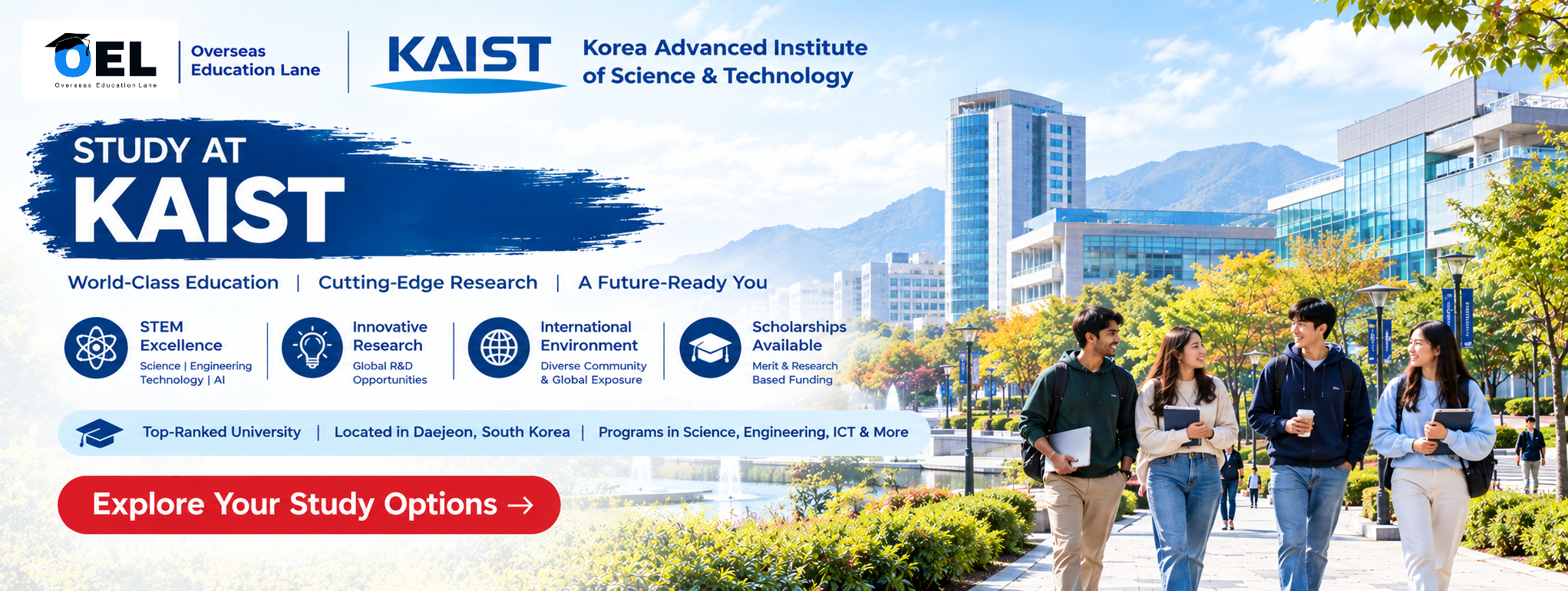
KAIST University: Admissions Guide for International Students
Are you interested in studying science, technology, engineering, or innovation in South Korea? KAIST (Korea Advanced Institute of Science and Technology) is an institution worth exploring if you want to build a strong academic foundation in science, engineering, computing, and research.
Located in Daejeon, South Korea, KAIST is known for its science and technology-focused academic environment. The university welcomes eligible international applicants to undergraduate and graduate programs, with admission requirements that depend on the degree level and application cycle.
For Indian students planning to study in South Korea, understanding KAIST admissions, eligibility, tuition fees, scholarships, and application deadlines can help you prepare effectively.
In this guide, Overseas Education Lane (OEL) explains the essential information international students should know before applying to KAIST.
____________________________________________________________________________________________
Why Choose KAIST in South Korea?
KAIST is a research-focused university offering academic opportunities in areas such as engineering, computer science, natural sciences, business and technology, and interdisciplinary research. Students interested in scientific discovery and technology-driven careers may find its academic environment particularly relevant.
Here are several reasons to consider KAIST:
• Science and technology education: Explore programs connected to engineering, computing, scientific research, and technological innovation.
• Undergraduate and graduate options: International students can investigate bachelor's, master's, integrated master's–PhD, and doctoral pathways where offered.
• English-language academic environment: KAIST identifies English as the official language of communication and instruction for international students, although individual requirements should be confirmed for the chosen program.
• Scholarship opportunities: Eligible international applicants can be considered for KAIST scholarship programs that may cover tuition and provide additional financial support.
• Research opportunities: Graduate students can explore academic departments and research areas aligned with their interests and qualifications.
Choosing a university involves more than its reputation. Consider the curriculum, research interests, career goals, funding options, and admission requirements before deciding whether KAIST is the right fit.
___________________________________________________________________________________________________________
KAIST Admissions for International Students
KAIST has dedicated admissions procedures for international undergraduate and graduate applicants. Students should use the relevant admissions website rather than relying on requirements intended for domestic applicants.
The official KAIST International Undergraduate Admissions website provides admission guides, eligibility criteria, application schedules, and financial support information. Graduate applicants should consult the separate KAIST International Graduate Admissions website.
Undergraduate Admissions
International students seeking a bachelor's degree should review the admission category and academic eligibility requirements carefully.
According to KAIST's published undergraduate eligibility guidelines, applicants must satisfy the applicable nationality and educational conditions. For international applicants, eligibility generally considers whether the applicant and their parents hold Korean citizenship or, in specified cases involving applicants of Korean origin, whether the applicant completed their entire elementary, junior high, and high school education outside Korea.
Applicants must also meet the relevant high school graduation requirements for their intended entry semester.
KAIST states that it does not offer a transfer program for international undergraduate applicants. Students applying through this route must apply as freshmen.
These conditions are important for Indian applicants and other international students because citizenship, family nationality, and educational history can affect eligibility.
Before beginning your application, confirm that your educational background and nationality meet the current international admissions criteria.
Graduate Admissions: Master's and PhD Programs
KAIST offers graduate pathways for students interested in advanced study and research.
Depending on the intended degree, applicants generally need:
• A recognised bachelor's degree or equivalent qualification for a master's or integrated master's–PhD program.
• A recognised master's degree or equivalent qualification for a doctoral program.
• Academic records demonstrating preparation for the intended field.
• English proficiency evidence where required.
• Recommendation letters and supporting documents specified in the relevant application guide.
Departmental expectations can differ, particularly for research-focused programs. Applicants should review the curriculum, faculty research areas, and any department-specific requirements before selecting a program.
For graduate applicants, matching your academic background and research interests with the intended department is an important part of preparing a competitive application.
___________________________________________________________________________________________________________
KAIST Eligibility and English Language Requirements
Meeting the eligibility requirements is an essential first step. KAIST assesses international applicants according to the relevant admissions guidelines, academic qualifications, and required supporting evidence.
Academic Eligibility
For undergraduate applicants, the relevant high school completion requirements depend on the intended entry semester. For the 2027 intake, KAIST's published guidelines specify high school graduation by February 28, 2027, for Spring entry and by August 31, 2027, for Fall entry.
Graduate applicants must satisfy the degree requirements applicable to their chosen program.
Review the official eligibility pages for the precise conditions:
KAIST undergraduate eligibility
KAIST graduate eligibility
English Language Requirements
KAIST uses English as its official language of communication and instruction for international students. However, applicants must follow the language evidence requirements specified for their degree and application cycle.
For international graduate admissions, the published requirements include the following English proficiency benchmarks:
Test | Published minimum score |
|---|---|
TOEFL iBT | 83 for tests taken before January 21, 2026; 4.5 under the revised scale for tests taken on or after that date |
IELTS Academic | 6.5 |
TOEIC Listening and Reading | 720 |
TEPS | 326 |
These figures relate to the published graduate admissions requirements and should not automatically be applied to undergraduate applicants. KAIST also specifies validity rules and certain exceptions or waiver provisions, which can depend on the applicant and admission cycle.
Check the current guide before booking a test, so you can prepare the right qualification and avoid unnecessary expenses.
___________________________________________________________________________________________________________
KAIST Tuition Fees and Cost of Living
Understanding the cost of studying at KAIST can help you plan your finances before applying. Your total expenses will depend on tuition, accommodation, food, health insurance, travel, and personal spending.
Tuition Fees
KAIST publishes tuition and cost-of-attendance information for international students. Its undergraduate cost information currently lists tuition of KRW 3,433,000 per semester, or KRW 6,866,000 for two semesters, before any applicable scholarship coverage.
These are published reference figures, not a guarantee of the amount payable for every student or future academic year. Confirm the applicable fees and any changes through the university's official undergraduate cost-of-attendance page.
Living Expenses
In addition to tuition, prepare a budget for:
• University accommodation or private housing.
• Meals and groceries.
• Books and study materials.
• Health insurance and medical expenses.
• Local transportation and communication.
• Personal expenses and international travel.
Accommodation costs can vary according to the room type and availability. Review the university's published estimates and consider additional expenses that may arise when you first arrive in South Korea.
Planning your total budget in advance will help you understand how much financial support you may need beyond tuition coverage.
___________________________________________________________________________________________________________
KAIST Scholarships for International Students
Scholarships are an important consideration for students planning to study abroad. KAIST offers scholarship opportunities for eligible international students, including undergraduate and graduate applicants.
However, scholarship coverage and selection conditions differ by degree level and funding scheme.
KAIST Scholarship for Undergraduate Students
According to KAIST's published undergraduate scholarship information, the KAIST Scholarship provides:
Full tuition exemption for eight semesters.
A monthly living stipend of KRW 350,000.
Medical health insurance support.
The university states that the scholarship is available to international student applicants admitted through the relevant process. Students must maintain a GPA above 2.7 on a 4.3 scale after their freshman year to meet the published academic continuation requirement.
The scholarship application is linked to the admissions process. Applicants should select the relevant scholarship option in the financial resources section of the online application, following the current instructions.
Read the official KAIST undergraduate scholarship guidelines to confirm the conditions that apply to your application.
KAIST Scholarships for Graduate Students
Graduate applicants can investigate the KAIST Scholarship and other applicable funding schemes.
The university's published graduate scholarship information describes support that can include full tuition coverage, national health insurance, and a monthly stipend. Stipend amounts and eligibility conditions depend on the program and scholarship scheme.
Eligible master's, integrated master's–PhD, and doctoral applicants may also be considered for particular funding programs, subject to their degree level and selection criteria.
Check the official KAIST graduate scholarship information for the latest details.
Global Korea Scholarship (GKS)
The Global Korea Scholarship is a Korean government scholarship program for eligible international students. KAIST publishes information about the GKS route for eligible graduate applicants, including support that can cover tuition, a monthly allowance, and round-trip airfare under the applicable scheme.
Eligibility, participating programs, selection procedures, and annual application dates are determined by the relevant scholarship guidelines. Consult the official Study in Korea portal for government scholarship announcements and current requirements.
Comparing the available scholarship routes early can help you identify suitable funding options and prepare the documents required for each application.
___________________________________________________________________________________________________________
KAIST Application Process: Step by Step
A clear application plan can help you prepare the right documents and avoid missing important submission requirements.
Choose your degree and program. Decide whether you are applying for an undergraduate, master's, integrated master's–PhD, or doctoral program.
Verify your eligibility. Check citizenship conditions, academic qualifications, graduation dates, and any degree-specific requirements.
Prepare your documents. Depending on your application, these may include academic transcripts, graduation certificates, identification and nationality documents, recommendation letters, and English proficiency scores.
Complete the online application. Follow the current official instructions and select the correct admission track.
Review scholarship options. Check whether you need to select a scholarship option or submit any additional information within your application.
Submit before the deadline. Ensure that the application and supporting documents are submitted within the specified period. Recommendation letters may have a separate deadline.
Monitor your application. Check official announcements and your application account for admission decisions and any additional instructions.
Organising your documents and tracking each deadline can make the application process more manageable.
___________________________________________________________________________________________________________
KAIST Admission Deadlines for 2027
KAIST publishes separate application timelines for undergraduate and graduate admissions. The deadlines are not necessarily the same.
Undergraduate Admission Schedule
KAIST's published schedule for 2027 international undergraduate admissions includes the following dates:
Admission track | Online application and document deadline | Recommendation deadline |
|---|---|---|
Spring 2027 early admission | October 22, 2026, at 6:00 PM KST | October 29, 2026, at 6:00 PM KST |
Fall 2027 regular admission | January 14, 2027, at 6:00 PM KST | January 21, 2027, at 6:00 PM KST |
As of October 21, 2026, the Spring 2027 early application deadline is approaching. Applicants should verify the current schedule and submit their applications promptly if eligible.
The university also lists a Fall 2027 early admission track. Review the official KAIST undergraduate application calendar for the full schedule and any subsequent updates.
Graduate Admission Schedule
KAIST's published general timeline lists Spring admission applications in mid-August to early September, Fall early-track applications in early to late December, and Fall regular-track applications in early to late March.
For 2027 entry, the university lists August 18–September 1, 2026, for Spring graduate admission and indicates that Fall 2027 dates are to be announced on the published timeline.
Because these dates may be updated and graduate application rounds can differ, consult the official KAIST graduate admissions timeline before planning your application.
Checking the official calendar regularly is the safest way to plan around confirmed deadlines rather than relying on dates from previous admission cycles.
___________________________________________________________________________________________________________
Frequently Asked Questions About KAIST
1. Can Indian students apply to KAIST?
Yes, Indian students can apply through KAIST's international admissions process if they meet the relevant academic, nationality, and other eligibility requirements. Applicants should check the current official guide for their chosen degree level.
2. Does KAIST offer scholarships to international students?
Yes. KAIST publishes undergraduate and graduate scholarship options that can include tuition coverage and additional financial support. Benefits and continuation conditions depend on the scholarship and degree program.
3. Is IELTS mandatory for KAIST?
Language requirements depend on the applicable admissions guidelines. KAIST publishes English proficiency requirements for international graduate applicants and specifies certain exceptions. Undergraduate applicants should consult their own admission guide.
4. How much are the tuition fees at KAIST?
KAIST's published undergraduate cost information lists tuition of KRW 3,433,000 per semester. Actual payable fees may vary, and eligible scholarship recipients may receive tuition coverage. Always check the latest official fee information.
5. When can international students apply to KAIST for 2027?
KAIST publishes separate application schedules for undergraduate and graduate programs. The undergraduate Spring 2027 early application deadline is October 22, 2026, while graduate dates vary by entry semester and application track. Check the official admission calendars for updates.
___________________________________________________________________________________________________________
Plan Your KAIST Application with Overseas Education Lane
Applying to a science- and technology-focused university such as KAIST requires careful preparation, from checking eligibility and choosing a suitable program to preparing academic documents and exploring scholarships.
Overseas Education Lane (OEL) helps Indian and other international students explore overseas education opportunities and understand the university application process. Our counseling team can help you assess your study options, understand the next steps, and plan your South Korea application journey.
Ready to explore KAIST? Visit Overseas Education Lane to enquire about a free counseling session and receive guidance tailored to your academic background and study goals.
Before applying, confirm current deadlines, tuition fees, scholarship conditions, eligibility requirements, and visa rules through the official university and government sources linked above, as these details may change.
Other Links
Top Destinations
Our Services
Contact Us
-
 Overseas Education Lane
-
 +91 892 992 2525
-
 [email protected]
-
[email protected]