
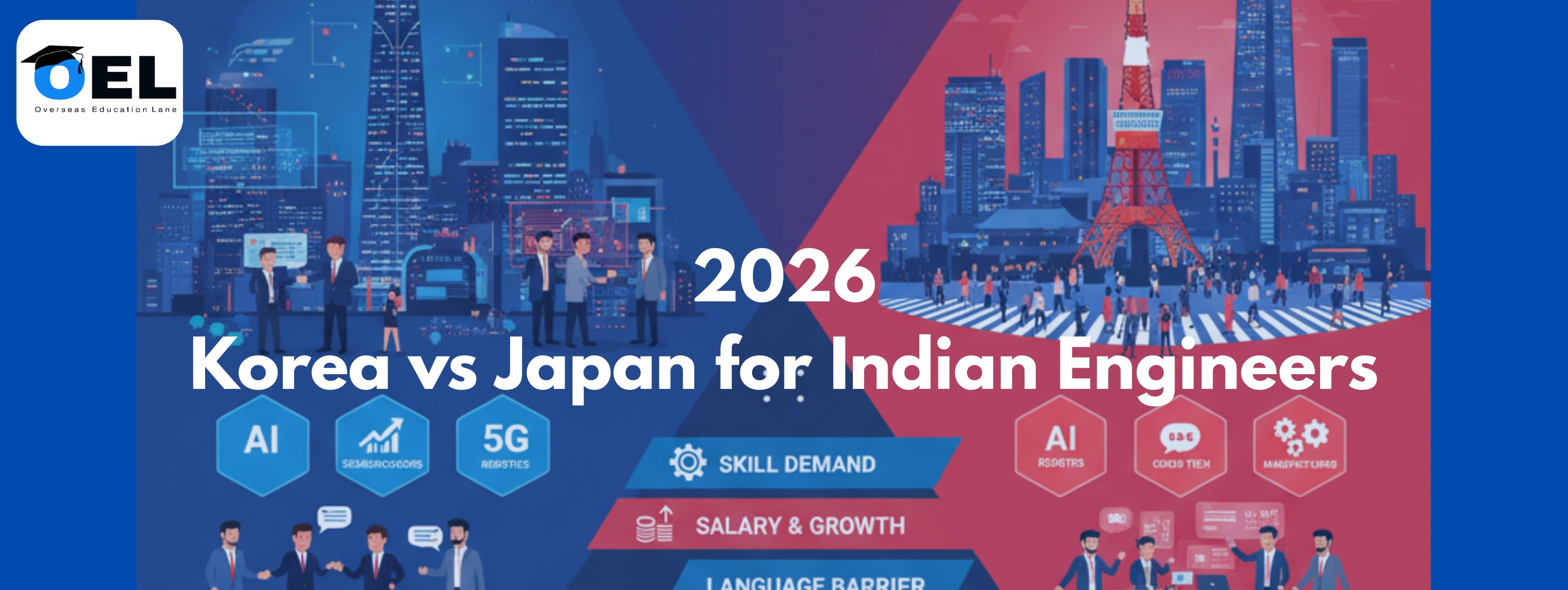
If you’re an Indian engineer weighing career moves abroad, the Korea vs Japan for Indian Engineers question matters — and fast. Tech giants (Samsung, LG, Toyota, Sony) and rising AI / semiconductor plays are hiring, but which country offers better jobs, pay, visas, and lifestyle for Indian professionals? This guide compares practical factors so you can decide with confidence. Korea vs Japan for Indian Engineers should be the first search you bookmark.
Crucial data & trends:
Both South Korea and Japan are doubling down on AI, semiconductors and digital transformation. South Korea’s IT services market is expanding quickly (projected high CAGR into 2030) while Japan’s IT and digital transformation markets are also large and growing, with major foreign investments in semiconductors and AI. These structural moves create sustained demand for engineers.
Jobs & demand: where the openings are?
South Korea: semiconductor + AI hiring
South Korea’s enterprise and semiconductor cluster hires engineers across hardware, firmware, and cloud-native roles. Look for engineering jobs in South Korea for Indians at chaebols and startups — roles often require specialized skills or sponsorship (E-7, D-10).
Japan: software, robotics & systems engineering
Japan’s demand skews toward software, systems, robotics and embedded systems — and recently AI chips as big investments arrive. English-friendly IT roles are increasingly available (especially in startups and international teams). Search engineering jobs in Japan for Indians on niche portals and recruiter networks.
Salary & cost-of-living: Net Take-Home Matters
Salary snapshots
Median software-engineer pay differs: South Korea ranges broadly (est. median totals around $46k–$89k depending on level and company), while Japan’s typical reports show mid-career totals in the ¥4.6–9.5M band (local surveys vary). Use company-level offers (Samsung vs Sony vs startups) to compare apples-to-apples.
Cost-of-living comparison
Tokyo and Seoul are both expensive, but Tokyo often shows higher living costs for rent and services; some indexes place Tokyo above Seoul by ~10–20% depending on basket. Factor housing, taxes, and remittance costs when comparing offers.
Visa & Relocation: How easy is it to move?
South Korea visa paths
Common routes include E-7 specialist visas, D-10 job-seeker visas, and special talent schemes for high-tech hires. Employers typically sponsor E-7 roles for engineers with the required credentials.
Japan visa paths
Japan requires a Certificate of Eligibility (COE) for skilled work visas; pathways include Engineer/Specialist in Humanities/International Services and the Specified Skilled Worker program for selective sectors. Language skills speed up integration and some visas. VFS Global+1
Real-world use-cases & company fit
Big Tech & Semiconductors (S. Korea): Best for hardware engineers, semiconductor process, firmware and integrated systems. Example roles: process engineer, SoC firmware lead.
Software & Robotics (Japan): Strong for systems engineers, robotics, automation and enterprise software. Example roles: backend engineer for factory automation, robotics control systems.
Table — At-a-glance
Factor | South Korea | Japan |
Top sectors | Semiconductors, AI, consumer electronics | Software, robotics, AI chips |
Visa route | E-7, D-10 (employer-sponsored) | COE + Skilled Worker / SSW |
Salary (typical) | Competitive for senior/hardware roles. $46k–$89k range reported. | 4.6M–9.5M JPY typical median ranges (varies). |
Cost of living | Slightly lower vs Tokyo (varies by city) | Often higher (Tokyo > Seoul on many indexes) |
Language | English roles growing, Korean helpful | Japanese often needed for full career growth |
Tips — Do’s & Don’ts
Do:
Negotiate total compensation (base + bonus + stock).
Check visa sponsorship & relocation package before accepting.
Learn basic local language (Korean/Japanese) — it multiplies opportunities.
Don’t:
Accept offers without clear sponsor/COE timelines.
Ignore healthcare, housing, and tax differences.
FAQs
Q: Which is better for software vs hardware engineers?
A: Hardware and semiconductor specialists often find stronger clusters in South Korea; software, robotics and enterprise systems frequently point to Japan.
Q: Are English-friendly roles available?
A: Yes — especially at startups, MNCs, and specific IT teams — but language skills boost promotion opportunities.
Choosing between Korea vs Japan for Indian Engineers comes down to your specialization, language willingness, and lifestyle preferences. If semiconductors and hardware excite you — lean Korea; if software, robotics, or system integration is your strength — Japan is compelling. Need help comparing offers or navigating visas? Contact Overseas Education Lane for tailored guidance on jobs, visa prep, and relocation planning.
Other Links
Top Destinations
Our Services
Contact Us
-
 Overseas Education Lane
-
 +91 892 992 2525
-
 [email protected]
-
[email protected]