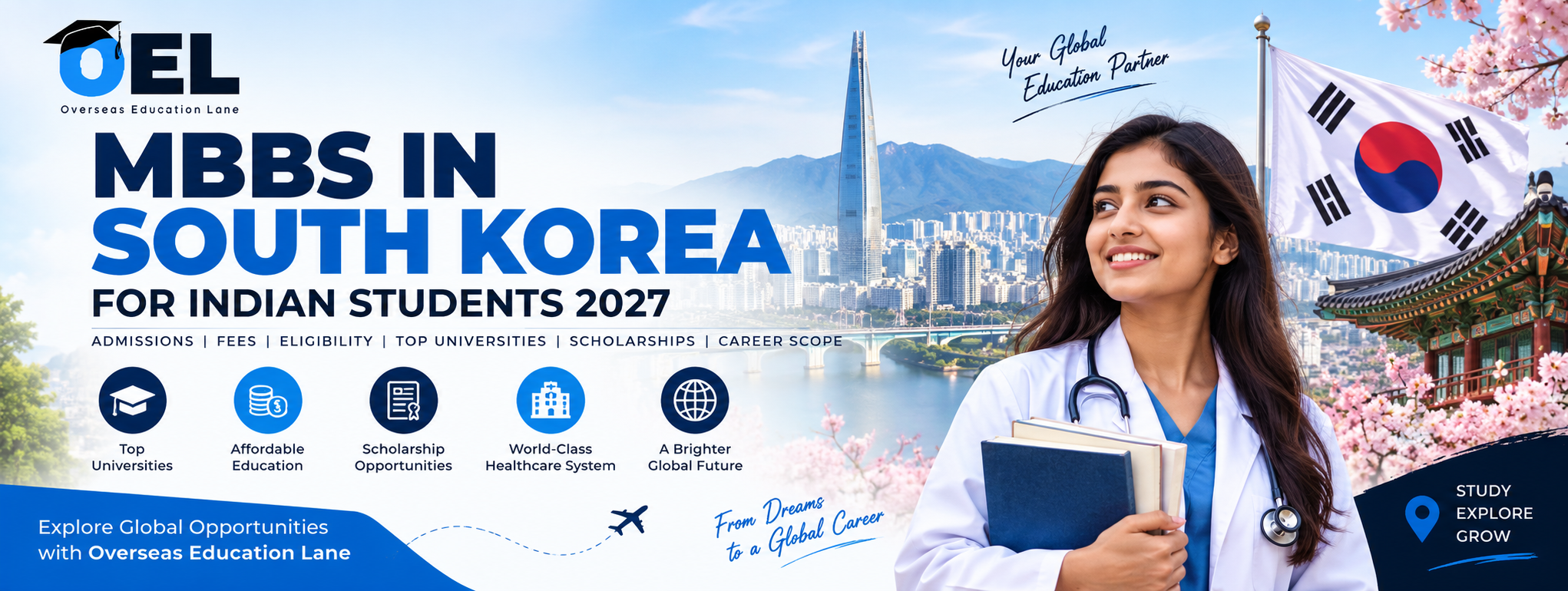
Dreaming of Becoming a Doctor in One of Asia's Most Advanced Countries?
South Korea has earned a global reputation for its technological innovation, world-class healthcare system, and internationally ranked universities. Home to some of Asia's leading hospitals and medical research institutions, South Korea is attracting growing interest from international students looking to pursue medical education abroad.
For Indian students planning their medical journey in 2027, South Korea offers a unique opportunity to study in a country known for cutting-edge medical research, advanced healthcare infrastructure, and exceptional academic standards.
However, before applying, students must understand the admission process, language requirements, eligibility criteria, tuition fees, scholarships, and career opportunities associated with studying medicine in South Korea.
This comprehensive guide from Overseas Education Lane (OEL) covers everything Indian students need to know about studying MBBS in South Korea in 2027.
Why Consider MBBS in South Korea?
South Korea's healthcare system is consistently ranked among the best in the world. The country invests heavily in medical research, biotechnology, artificial intelligence in healthcare, and advanced treatment technologies.
Students studying medicine in South Korea benefit from:
Globally Recognized Universities
South Korean universities are regularly featured in international rankings and are respected for their academic excellence and medical research output.
Advanced Clinical Training
Medical students gain hands-on experience in modern teaching hospitals equipped with the latest healthcare technologies and treatment facilities.
Research Opportunities
South Korea is a global leader in biotechnology, pharmaceuticals, regenerative medicine, robotics, and healthcare innovation.
Safe and Modern Environment
The country offers excellent public transportation, high living standards, and one of the safest environments for international students.
International Career Opportunities
Graduates can explore careers in healthcare, medical research, biotechnology, pharmaceuticals, and public health across multiple countries.
Can Indian Students Study MBBS in South Korea?
Yes, Indian students can apply to study medicine in South Korea.
However, unlike India, the term "MBBS" is not commonly used. Most universities offer medical degree programs that eventually lead to a Doctor of Medicine (MD) qualification.
Students should note that admission to Korean medical schools is highly competitive and most programs require proficiency in the Korean language.
Duration of Medical Studies in South Korea
Medical education in South Korea generally follows a six-year structure.
Typical Program Structure
Pre-Medical Education: 2 Years
Students study biology, chemistry, anatomy, physiology, and foundational sciences.
Medical Studies: 3 Years
Advanced medical subjects, laboratory training, diagnostics, pathology, pharmacology, and patient care.
Clinical Internship: 1 Year
Practical hospital-based training under the supervision of experienced healthcare professionals.
Total Duration
6 Years
Top Medical Universities in South Korea for International Students
Seoul National University
Seoul National University is regarded as South Korea's most prestigious university and is known for its highly competitive medical programs and advanced research facilities.
Highlights
Globally ranked institution
World-class teaching hospital
Extensive research opportunities
Strong international reputation
Yonsei University College of Medicine
One of Korea's oldest and most respected medical institutions, Yonsei University provides exceptional clinical exposure through Severance Hospital.
Highlights
Strong medical research ecosystem
International student support
Excellent hospital network
Korea University College of Medicine
Korea University is recognized for academic excellence, innovation, and healthcare research.
Highlights
Modern laboratories
Clinical training programs
International collaborations
Sungkyunkwan University School of Medicine
Affiliated with Samsung Medical Center, this institution is among Korea's leading medical schools.
Highlights
Strong industry partnerships
Advanced medical technology exposure
Research-focused curriculum
Hanyang University College of Medicine
Hanyang University combines healthcare education with innovation and medical technology.
Highlights
Modern campus facilities
Research-driven learning
Industry-oriented programs
MBBS Fees in South Korea for Indian Students
The overall cost of studying medicine in South Korea depends on the university, city, and scholarship availability.
Students who secure scholarships can significantly reduce their overall expenses.
Eligibility Criteria for MBBS in South Korea 2027
Indian students must satisfy the following requirements:
Academic Requirements
Completion of Class 12
Physics, Chemistry, and Biology as core subjects
Strong academic performance
Good English communication skills
Language Requirements
Most Korean medical programs require proficiency in Korean.
Students may need:
TOPIK certification
Intermediate to advanced Korean language proficiency
Additional Documents
Passport
Academic transcripts
Statement of Purpose
Recommendation Letters
Passport-size photographs
Medical fitness certificate
Is NEET Required for MBBS in South Korea?
Yes.
Indian students planning to return to India for medical practice should qualify NEET before pursuing medical education abroad.
NEET qualification is important for meeting future eligibility requirements related to medical licensing and recognition in India.
Scholarships for Indian Students
One of the biggest advantages of studying in South Korea is access to scholarship opportunities.
Global Korea Scholarship (GKS)
The Korean Government offers the prestigious Global Korea Scholarship for international students.
Benefits often include:
Full tuition waiver
Monthly stipend
Airfare support
Settlement allowance
Medical insurance
Korean language training support
University Scholarships
Many universities offer:
Merit-based scholarships
Academic excellence awards
International student grants
Research scholarships
Outstanding students can receive substantial tuition fee reductions.
Cost of Living in South Korea
Compared with countries such as the USA, UK, and Australia, South Korea offers a relatively affordable student lifestyle.
Average Monthly Expenses
Accommodation: ₹20,000–₹40,000
Food: ₹15,000–₹25,000
Transportation: ₹5,000–₹10,000
Miscellaneous: ₹10,000–₹20,000
Students generally spend between ₹50,000 and ₹90,000 per month depending on lifestyle and location.
Career Opportunities After MBBS in South Korea
Graduates can pursue careers in:
Clinical Practice
Work in hospitals and healthcare institutions after meeting licensing requirements.
Medical Research
Join research organizations, universities, and healthcare innovation centers.
Pharmaceutical Industry
South Korea's pharmaceutical and biotechnology sectors offer strong career prospects.
Public Health
Work with healthcare agencies, NGOs, and international organizations.
Higher Education
Pursue postgraduate medical specialization and advanced clinical training.
Why Choose Overseas Education Lane for South Korea Admissions?
At Overseas Education Lane (OEL), we help students navigate every step of their international education journey.
Our expert counselors provide:
✔ University Selection Guidance
✔ Admission Assistance
✔ Scholarship Support
✔ Documentation Assistance
✔ SOP & Application Review
✔ Student Visa Guidance
✔ Pre-Departure Support
Whether you are exploring medical education, engineering, business, AI, data science, or healthcare programs in South Korea, OEL helps you choose the right university and build a successful global career.
Frequently Asked Questions
Is South Korea good for MBBS?
South Korea offers high-quality medical education, advanced healthcare infrastructure, and excellent research opportunities for students seeking international exposure.
Can Indian students study medicine in South Korea?
Yes, Indian students can apply to Korean medical universities if they meet academic and language requirements.
What is the duration of MBBS in South Korea?
Medical education typically takes six years, including pre-medical studies, medical training, and clinical internships.
Is Korean language mandatory?
In most cases, yes. Clinical training and patient interaction often require proficiency in Korean.
Are scholarships available?
Yes. Students can apply for Global Korea Scholarships and university-specific scholarship programs.
Other Links
Top Destinations
Our Services
Contact Us
-
 Overseas Education Lane
-
 +91 892 992 2525
-
 [email protected]
-
[email protected]