
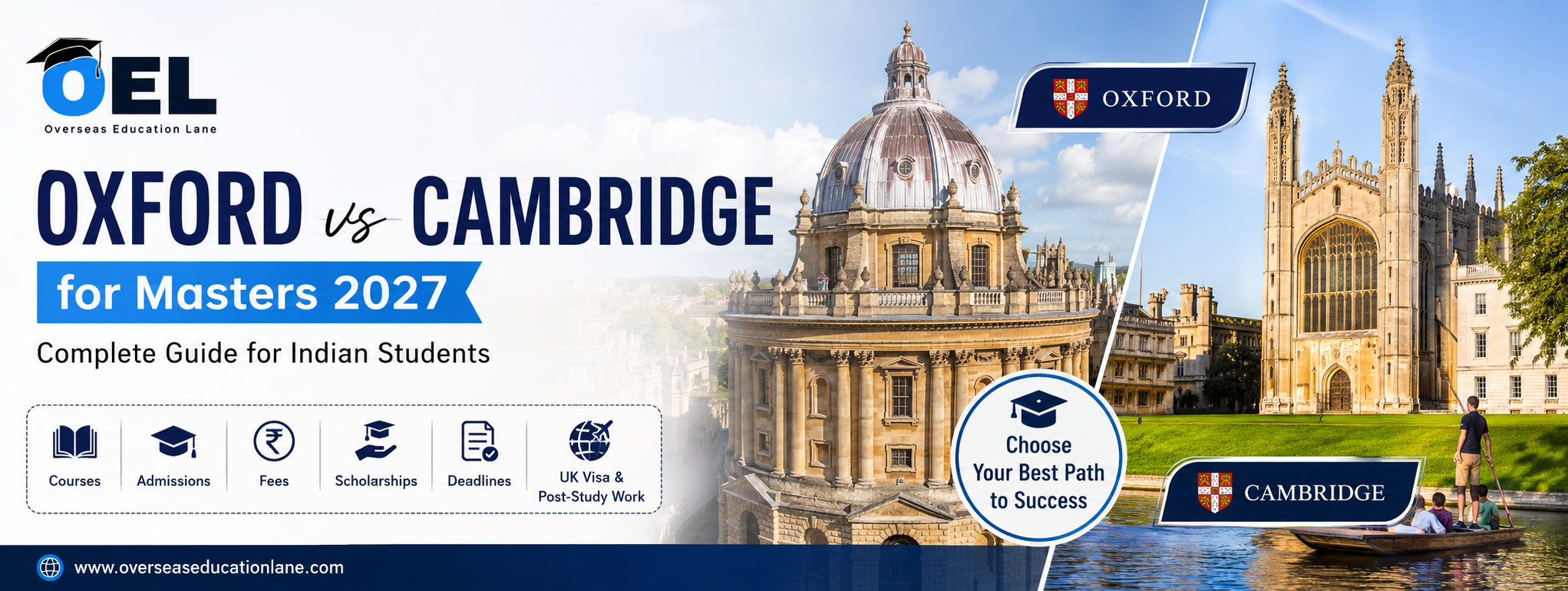
For students planning to pursue a Masters in the UK in 2027, few academic decisions are as exciting—or as difficult—as choosing between the University of Oxford and the University of Cambridge. Both universities are recognised globally for academic excellence, research, influential alumni networks and highly competitive postgraduate programmes.
For Indian students, however, the Oxford vs Cambridge for Masters 2027 comparison should go much deeper than university rankings. The right choice depends on the course you want to study, your academic profile, research interests, career ambitions, tuition budget, scholarship possibilities and the type of learning environment you prefer.
Students frequently search for terms such as Oxford vs Cambridge MS 2027, although UK universities do not always use the American-style MS title. Oxford offers postgraduate qualifications such as MSc, MPhil and MSt, while Cambridge offers many postgraduate degrees under the MPhil and other qualification titles. Therefore, students looking for an "Oxford MS" or "Cambridge MS" should always identify the exact programme and qualification offered by the university.
If you are preparing for the 2027 UK university intake, this guide explains the differences between Oxford and Cambridge for master's students, including courses, admission requirements, potential costs, IELTS requirements, scholarships, application timelines, career opportunities and the latest UK post-study work rules.
Oxford vs Cambridge for Masters 2027: Understanding Oxbridge
Oxford and Cambridge are collectively known as Oxbridge, a term that reflects the academic prestige and historical importance of the two universities.
Both institutions operate through a collegiate structure. As a postgraduate student, you generally belong to an academic department responsible for your degree as well as a college that contributes to your wider university experience.
Oxford offers a very broad postgraduate portfolio spanning computer science, mathematics, engineering, medicine, law, economics, public policy, humanities, social sciences, business and many interdisciplinary fields.
Cambridge is similarly strong across engineering, computer science, mathematics, physical sciences, biological sciences, economics, finance, management, social sciences and humanities.
Because both universities are exceptional, the question should not simply be "Is Oxford better than Cambridge?" Instead, applicants should ask which university offers the stronger course, research environment and career fit for their particular field.
Oxford or Cambridge: Which Is Better for Masters in 2027?
There is no universal winner in an Oxford vs Cambridge Masters comparison.
Cambridge has an exceptional global reputation in mathematics, engineering, physics, computer science and scientific research. Its surrounding innovation ecosystem also makes Cambridge attractive to students interested in technology, research, startups and entrepreneurship.
Oxford combines world-leading science and technology departments with particularly influential programmes in areas such as law, politics, economics, public policy, philosophy, humanities and interdisciplinary research.
This does not mean that Cambridge should automatically be chosen for STEM or Oxford for humanities. Both universities have excellent programmes across a much wider range of disciplines.
For example, applicants interested in computer science should compare Oxford's MSc in Advanced Computer Science with Cambridge's MPhil in Advanced Computer Science by looking at module structure, prerequisites, faculty, research interests and career objectives.
The strongest Oxford vs Cambridge decision for 2027 therefore comes from comparing individual programmes rather than trying to rank two entire universities against one another.
Oxford Masters Courses for 2027
Oxford offers postgraduate programmes across hundreds of specialisations. Indian students commonly explore fields such as Advanced Computer Science, Mathematical Sciences, Economics, Financial Economics, Public Policy, Law, International Relations, Sustainability, Business, Data-related disciplines and scientific research.
A major strength of Oxford is its interdisciplinary academic environment. Students interested in combining technology with public policy, economics with social research or science with entrepreneurship can find programmes that draw expertise from multiple departments.
Applicants targeting Oxford Masters 2027 should carefully examine the entry requirements attached to their desired course because eligibility varies significantly between departments.
Some programmes require a strong degree in a closely related academic discipline. Others may place additional emphasis on mathematics, programming ability, research experience, professional background or previous coursework.
Cambridge Masters Courses for 2027
Cambridge also offers an extensive portfolio of postgraduate courses, including popular programmes in Advanced Computer Science, Engineering, Mathematics, Economics, Finance, Biotechnology, Natural Sciences, Physics, International Relations and management-related subjects.
One point that often confuses international students is Cambridge's use of the MPhil title. An MPhil at Cambridge can include substantial taught coursework and should not automatically be interpreted in the same way as an Indian MPhil.
Students looking for a Cambridge MS 2027 should therefore search by subject rather than qualification title alone.
Cambridge can be particularly attractive for students interested in research-intensive environments and fields connected to its strong science, technology and innovation ecosystem.
Oxford vs Cambridge Rankings for 2027
Students frequently search for Oxford vs Cambridge ranking 2027 while deciding between the universities.
Both Oxford and Cambridge regularly appear among the world's leading institutions. However, ranking organisations use different methodologies. One ranking may emphasise research citations, another employer reputation, and another international outlook, sustainability or teaching metrics.
This means a slight movement between Oxford and Cambridge in a global ranking should not determine your master's choice.
Subject rankings can be more useful, but even these should be combined with analysis of programme content, faculty expertise, research centres, career outcomes and scholarships.
For a postgraduate student, the difference between being ranked among the very best universities in the world and another institution that is also among the very best universities in the world is far less important than whether the programme actually supports your career objective.
Oxford vs Cambridge Fees for Indian Students in 2027
Cost is one of the most important aspects of the Oxford vs Cambridge for Indian students comparison.
There is no single tuition fee applicable to every master's programme at either university. Fees vary according to subject, course duration and fee status.
As of August 2026, Oxford's complete 2027–28 graduate application guidance and course-specific 2027 fee information have not yet been published across all programmes. Oxford states that applications for 2027–28 entry will open in September 2026 and that updated guidance will become available around that period.
This is important for SEO content because students should not be shown a 2026 tuition fee and told that it is definitely the Oxford Masters fee for 2027.
The same principle should be applied to Cambridge. Tuition varies by programme, and prospective students should calculate their budget using the exact fee published for the 2027–28 intake once available.
Apart from tuition, Indian students should budget for accommodation, food, local transportation, books, university-related expenses, visa charges, Immigration Health Surcharge, flights, deposits and personal expenditure.
Because the pound-to-rupee exchange rate can move significantly, students should also maintain a financial buffer instead of converting tuition to INR only once at the beginning of the application process.
Total Cost of Studying at Oxford or Cambridge for Indian Students
The cost of studying in UK for Indian students cannot be calculated through tuition alone.
Accommodation is generally the largest additional expense. Food, transport, mobile services, books, societies, clothing, personal expenses and travel should also be included.
Oxford and Cambridge both have college systems, and accommodation availability and pricing can vary by college.
International students should therefore create three separate budget categories: tuition fees, estimated living expenses and one-time costs such as visa fees, flights and deposits.
Students considering education loans should also calculate interest costs and repayment expectations before committing to a high-cost postgraduate programme.
This is one of the areas in which working with a UK study consultant or education-loan advisor can be useful, particularly when families need to compare scholarships, loan options and the total financial commitment involved.
Oxford Masters Admission Requirements for Indian Students 2027
Oxford Masters admission requirements for Indian students depend on the programme.
Some postgraduate courses require academic performance equivalent to a strong UK first-class degree, while others specify an upper-second-class equivalent or programme-specific prerequisites.
Oxford applications can also involve transcripts, references, academic statements or Statements of Purpose, CVs, writing samples and research-related documents depending on the programme.
Applicants should remember that meeting minimum eligibility does not mean that admission is likely.
Oxford receives applications from academically strong students from across the world. Competitive programmes therefore assess not only whether a student meets the requirements but whether the candidate demonstrates exceptional preparation and programme fit.
Students applying from India should clearly explain how their previous degree, research projects, internships, work experience or academic interests connect to the programme.
Cambridge Masters Admission Requirements for Indian Students 2027
Cambridge follows a similarly selective admissions process.
Entry requirements vary between postgraduate courses, and candidates should evaluate their Indian academic qualifications against the university's international equivalency guidance and the requirements stated for the individual programme.
Some courses may require extensive mathematical or technical preparation. Others may place greater weight on research experience, written work or relevant academic background.
Certain Cambridge programmes also ask applicants to discuss research interests.
For example, the MPhil in Advanced Computer Science currently requires applicants to indicate areas of academic interest and propose a research direction as part of the application process.
This is why students preparing for Cambridge Masters 2027 admission should begin programme research early instead of writing a generic SOP shortly before the deadline.
Oxford vs Cambridge Acceptance Rate
Searches for Oxford vs Cambridge acceptance rate for Masters are extremely common, but university-wide percentages can be misleading.
Admission difficulty varies dramatically by course.
A postgraduate programme with hundreds of applicants competing for a small cohort may be much harder to enter than another programme within the same university.
Instead of asking, "What is the Cambridge acceptance rate?" or "What is the Oxford acceptance rate?", students should investigate the admissions statistics and competitiveness of their exact programme wherever data is available.
Your own competitiveness will also depend on your academic record, university background, subject preparation, references, research work, professional experience and application quality.
Acceptance-rate statistics should therefore be used for context—not as the main reason to apply or avoid applying.
Oxford vs Cambridge IELTS Requirements for Indian Students
English-language requirements differ depending on the programme.
Oxford currently categorises postgraduate English requirements into different levels, with individual course pages identifying which level applies.
Applicants should therefore not assume that every Oxford programme has one standard IELTS requirement.
Cambridge also publishes English-language requirements by postgraduate course.
Students searching for Oxford vs Cambridge IELTS requirement 2027 should verify the official course requirement after the 2027–28 application cycle opens, particularly because universities can update admissions policies between cycles.
Indian students should ideally complete IELTS or another accepted English-language qualification well before their application deadline when their programme requires it.
A strong English-language foundation is also useful beyond admission because both Oxford and Cambridge involve extensive academic reading, seminars, research writing and presentations.
SOP for Oxford and Cambridge Masters 2027
A strong SOP or academic statement is one of the most important parts of a competitive postgraduate application.
The biggest mistake applicants make is spending most of the statement praising Oxford or Cambridge.
Admissions teams already know their university is prestigious.
What they want to understand is why you are academically suited to the programme.
Your statement should show how previous coursework, research, internships or professional experience created your interest in the subject. It should then explain why the particular master's programme is the logical next step.
If a course contains specific modules or research themes closely connected to your goals, those links should be discussed naturally.
Generic statements such as "Oxford is my dream university" or "Cambridge is globally ranked" contribute very little.
A strong application instead demonstrates academic direction, intellectual maturity and a clear understanding of what the programme actually offers.
Oxford vs Cambridge Scholarships for Indian Students 2027
Scholarships can significantly affect the affordability of an Oxbridge master's degree.
Oxford offers university-wide, departmental and college funding opportunities, including major graduate scholarship programmes. Cambridge likewise offers funding through university schemes, colleges, the Cambridge Trust and other scholarship programmes.
Indian applicants should also explore external scholarships available for international education.
The critical point is timing.
Many major scholarship decisions are tied to earlier university application deadlines. Students who begin searching for scholarships only after receiving an admission offer may discover that some important funding opportunities have already closed.
Students targeting Oxford and Cambridge scholarships 2027 should therefore identify scholarships alongside course selection.
Scholarship planning should consider eligibility, separate application requirements, course deadlines, academic merit criteria and whether the award covers tuition only or also contributes to living expenses.
Oxford and Cambridge Application Deadline 2027
Applicants planning for Oxford Masters 2027 should be aware that the new admissions cycle is approaching.
Oxford has confirmed that applications for 2027–28 graduate entry will open in September 2026. The university also says updated application guidance for the 2027–28 cycle will become available from around mid-September 2026.
Exact deadlines will vary by course.
This means there is no single Oxford Masters deadline that should be applied across every programme.
Cambridge postgraduate programmes also operate with course-specific deadlines, meaning applicants must check their target programme carefully once the relevant 2027 entry information is live.
Cambridge currently charges an application fee of £85 for most non-doctoral postgraduate degree applications, although fee-waiver provisions exist for eligible applicants.
Students planning for the 2027 intake should ideally begin profile evaluation, programme research, IELTS preparation, SOP development and referee conversations before applications open.
Suggested Timeline for UK Masters 2027 Applicants
Students intending to begin a UK master's degree in 2027 should start researching universities during 2026.
The months before applications open can be used to shortlist courses, assess academic eligibility, prepare for IELTS or other required tests, approach potential referees and identify scholarships.
Once Oxford, Cambridge and other UK universities publish their final 2027–28 course pages, applicants should verify every requirement against official information.
Applications to highly competitive programmes should preferably not be left until the final deadline.
Early preparation is especially important when a course requires writing samples, a research proposal, professional references or specialised testing.
Oxford vs Cambridge for Computer Science 2027
For students comparing Oxford vs Cambridge for Computer Science Masters, both institutions offer outstanding academic environments.
Oxford's Advanced Computer Science programme covers advanced areas of computer science and is designed for students with strong foundations in computer science or mathematics.
Cambridge's Advanced Computer Science postgraduate offering combines advanced study with research-oriented work and asks applicants to think carefully about the academic areas they want to explore.
Students planning careers in artificial intelligence, machine learning, software engineering, research, cybersecurity or emerging technology should not choose only on university reputation.
Research groups, modules, academic supervisors, dissertation possibilities and intended career outcomes should determine which programme represents the stronger fit.
Oxford vs Cambridge for Engineering
Cambridge has one of the strongest global reputations in engineering and maintains deep links with scientific research and technology innovation.
Oxford also offers exceptional engineering and related research programmes.
Students comparing Oxford vs Cambridge Engineering Masters 2027 should evaluate the exact specialisation, because the strengths of individual departments and research groups matter far more than a generic university-level comparison.
A candidate interested in energy systems, biomedical engineering or artificial intelligence may reach a different conclusion from someone specialising in theoretical or mechanical engineering.
Oxford vs Cambridge for Finance, Economics and Business
Both universities offer excellent environments for students interested in finance, economics, management and entrepreneurship.
Oxford's Saïd Business School attracts students from around the world and sits within the wider Oxford academic ecosystem.
Cambridge Judge Business School similarly combines business education with the university's strong technology, research and entrepreneurship environment.
For economics and finance courses, applicants should pay particular attention to quantitative prerequisites.
A strong business profile alone may not satisfy the mathematical preparation required for certain economics or finance programmes.
Students applying for an MBA should make a different comparison altogether, focusing heavily on work experience, leadership, career goals, cohort profile, recruiting opportunities and return on investment.
Oxford vs Cambridge for Indian Students: Student Life
Oxford and Cambridge are both historic university cities with large international student populations.
The collegiate environment gives students access to communities that extend beyond their academic departments. This can be especially valuable for international students who are moving to the UK for the first time.
Oxford is often perceived as somewhat larger and busier, while Cambridge has a strong academic-town character and major connections to technology and research businesses.
Both cities offer extensive societies, cultural activities, libraries, academic talks and networking opportunities.
The "better" location therefore depends heavily on your personality and preferred environment.
Students should also investigate college accommodation availability because securing convenient university or college accommodation can affect both lifestyle and budget.
Career Opportunities After Oxford or Cambridge
An Oxford or Cambridge master's degree can provide considerable career value because both institutions are recognised by employers around the world.
Graduates move into industries such as consulting, financial services, technology, academia, research, engineering, healthcare, public policy, law, entrepreneurship and international organisations.
However, an Oxbridge degree does not automatically guarantee employment.
Career outcomes continue to depend on your previous experience, technical or professional skills, networking, interview performance, visa situation and labour-market conditions.
Applicants should therefore investigate career prospects before choosing a master's course rather than assuming that university prestige alone will create the desired outcome.
UK Post-Study Work Visa Rules for 2027 Students
Students planning to study in UK in 2027 need to pay particular attention to the UK's Graduate visa rules because many older articles still state that master's graduates automatically receive two years of post-study work permission.
That information is now outdated for future applicants.
Under the current UK Immigration Rules, graduates completing eligible bachelor's or master's qualifications receive 18 months under the Graduate route when their application is made on or after 1 January 2027. Doctoral graduates continue to receive three years.
This means a student beginning a typical UK master's course in September or October 2027 would, under the rules currently in force, expect an 18-month Graduate visa after successful completion, rather than the old two-year period.
The Graduate route allows eligible students to remain in the UK and work or look for work without employer sponsorship during that period.
Immigration rules can change, so students should always confirm the latest policy on GOV.UK before making their final study and financial decisions.
Is Oxford or Cambridge Better for Indian Students in 2027?
The best university depends on your own academic and professional objectives.
A student interested in advanced scientific research may find the perfect research group at Cambridge. Another applicant pursuing public policy may discover that Oxford's programme structure better matches their goals.
Someone studying computer science might receive offers from both institutions and then choose based on modules, faculty interests, dissertation possibilities and career ambitions.
The prestige difference between Oxford and Cambridge is simply not large enough to justify selecting an unsuitable programme.
If you receive offers from both universities, compare course structure, total expenditure, scholarships, research opportunities, career outcomes, college experience and personal preference before making a decision.
How Overseas Education Lane Can Help With Oxford and Cambridge Applications for 2027
Applying to Oxford, Cambridge and other competitive UK universities involves much more than completing an online form.
Students must identify suitable programmes, understand academic requirements, organise transcripts and recommendations, prepare compelling application documents, investigate scholarships and plan their finances.
Overseas Education Lane (OEL) provides study-abroad guidance designed to support students across different stages of this journey.
For students targeting the UK Masters 2027 intake, OEL can help with profile assessment and university selection so that applicants understand which programmes align with their academic history, future ambitions and budget.
This can be particularly useful for applicants targeting Oxford or Cambridge because an aspirational university strategy should also include realistic and well-matched alternatives.
OEL also provides support related to admission applications, SOP and LOR guidance, scholarship exploration, test preparation, education loans and visa guidance.
Instead of treating each stage independently, students can build an application roadmap that begins with identifying the correct programme and continues through the later stages of the overseas education process.
Overseas Education Lane for SOP and LOR Guidance
Competitive UK admissions require application documents that reflect the student's own academic and professional journey.
A strong SOP should communicate programme fit rather than simply repeat achievements from a CV.
Likewise, recommendation letters should provide credible insight into academic ability, professional performance or research potential.
With structured application guidance, students can better understand what each document needs to communicate and how their overall profile should be presented consistently.
This is especially important for students targeting Oxford, Cambridge and other selective UK universities where generic applications can struggle against a highly qualified international applicant pool.
Overseas Education Lane for UK Scholarships and Education Loans
Financing international education is one of the biggest concerns for Indian students.
OEL's study-abroad support includes scholarship and education-loan guidance, helping students understand potential funding options while planning their UK education.
Students should compare scholarship conditions carefully and assess whether an award covers tuition, living expenses or only a portion of the overall cost.
Those considering an education loan should similarly compare interest rates, repayment conditions, processing charges and the total cost of borrowing.
Financial planning becomes especially important for universities such as Oxford and Cambridge because overall study costs can be substantial.
Overseas Education Lane for UK Student Visa Guidance
Receiving a university offer is not the final stage of the process.
International students must complete the necessary immigration formalities before travelling to the UK.
OEL also provides student visa guidance, helping students understand the documentation and application process involved after securing admission.
Because UK immigration policies can change, students should always use current official information and avoid relying on outdated social-media videos or older blog articles when planning their visa journey.
Why Choose Overseas Education Lane as Your UK Study Consultant?
Students searching for the best UK study consultant, UK study consultant in India, best study abroad consultant for UK or overseas education consultant for UK should look beyond simple university application submission.
Effective counselling should begin with understanding the student's academic background, career objective, preferred subject, budget and university expectations.
Overseas Education Lane supports students through areas including university and course selection, admission guidance, SOP and LOR support, scholarship guidance, test preparation, education loans and student visa guidance.
For applicants pursuing Masters in UK in 2027, this broad support can make it easier to coordinate the many decisions involved in studying abroad.
Students targeting highly competitive institutions such as Oxford and Cambridge can also benefit from building a balanced UK university shortlist instead of placing their entire application strategy around two universities.
Therefore, for students looking for a UK admission consultant in India or support while planning their 2027 UK master's applications, Overseas Education Lane can serve as a comprehensive overseas education guidance partner.
Frequently Asked Questions About Oxford vs Cambridge Masters 2027
Is Oxford or Cambridge better for Masters in 2027?
Neither Oxford nor Cambridge is universally better for every master's degree. Both are among the world's leading universities. The right choice depends on your subject, programme curriculum, research interests, academic background, scholarships, budget and career plans. Students should compare specific courses rather than choose solely on overall university rankings.
Can Indian students apply to both Oxford and Cambridge for Masters?
Yes. Postgraduate applicants can apply to both Oxford and Cambridge. Students should prepare each application according to the requirements of the specific programme rather than submitting an identical SOP or academic statement to both universities.
When do Oxford Masters applications open for 2027?
Oxford has confirmed that its application form for 2027–28 graduate study will become available from September 2026. Updated guidance for the new admissions cycle will also be published around that period. Exact deadlines will depend on the individual programme.
What is the Oxford Masters application deadline for 2027?
There is no single deadline for all Oxford postgraduate courses. Course-specific deadlines for the 2027–28 intake should be checked on Oxford's official graduate admissions pages once the new application cycle is fully published.
What is the Cambridge Masters application deadline for 2027?
Cambridge postgraduate deadlines vary according to the programme. Applicants should check the individual Cambridge course directory page for their intended 2027 entry course rather than relying on one general deadline.
What is the application fee for Cambridge Masters?
Cambridge currently charges £85 per application for most non-doctoral postgraduate degree courses, with application-fee waivers available in eligible circumstances. Applicants for the 2027 cycle should verify that the amount has not changed before applying.
What is the Oxford Masters application fee?
Oxford's current standard application fee is £75 for taught graduate courses and £20 for research courses. Because applicants targeting 2027–28 entry will apply in a new admissions cycle, they should verify the published fee after the updated application guidance goes live.
How much does an Oxford Masters cost for Indian students in 2027?
Tuition varies significantly according to the programme. Oxford has not yet published complete 2027–28 fee information for every graduate programme as of August 2026. Applicants should use the official 2027 course page once available rather than treating previous-year tuition as a confirmed 2027 fee.
How much does a Cambridge Masters cost in 2027?
Cambridge postgraduate tuition varies by course and international fee status. Applicants should verify the exact 2027–28 University Composition Fee and additional expenses for their selected course once the relevant information is published.
What IELTS score is required for Oxford and Cambridge Masters 2027?
English-language requirements depend on the programme. Oxford uses course-specific English requirement levels, while Cambridge also specifies requirements for individual courses. Applicants should check their target programme's official 2027 entry page before booking or submitting an English-language test.
Are Oxford and Cambridge difficult to get into for Masters?
Yes. Both universities attract highly qualified applicants from around the world. However, selectivity differs considerably by programme. Academic results are important, but admission can also depend on subject preparation, references, research experience, written work, professional background and the strength of your academic statement.
Are scholarships available for Indian students at Oxford and Cambridge?
Yes. Indian students can explore university, college and external scholarships for both institutions. Major scholarships may have earlier application deadlines, so funding research should begin at the same time as university shortlisting rather than after receiving an offer.
Is Oxford better than Cambridge for Computer Science?
Both universities have exceptionally strong computer science departments. The better choice depends on your intended specialisation, modules, research interests and career objectives. Students should compare the exact Oxford and Cambridge postgraduate computer science programmes instead of deciding solely through overall rankings.
Is Cambridge better than Oxford for Engineering?
Cambridge has an outstanding international reputation for engineering, but Oxford also conducts world-class engineering research. The correct choice depends on your engineering specialisation, available faculty and research groups, programme structure and intended career path.
How long is the UK post-study work visa for Masters students in 2027?
Under current UK Immigration Rules, an eligible bachelor's or master's graduate who applies for the Graduate visa on or after 1 January 2027 receives 18 months of permission, while eligible PhD and other doctoral graduates receive three years.
Is studying in the UK in 2027 worth it for Indian students?
It can be worthwhile when the chosen programme offers strong academic value, relevant career opportunities and a financially sensible return on investment. Students should evaluate tuition, living costs, scholarship options, employment prospects and the current 18-month Graduate visa framework before deciding.
Can Overseas Education Lane help with Oxford and Cambridge applications?
Yes. Overseas Education Lane provides guidance across areas such as university selection, admission support, SOP and LOR preparation, scholarship guidance, test preparation, education loans and student visa support. Students targeting Oxford, Cambridge or other UK universities can use this support while building their 2027 application strategy.
Which is the best UK study consultant for Indian students?
The best UK study consultant should provide personalised advice based on the student's academic profile, intended programme, career objectives and budget rather than recommending identical universities to every applicant. Students looking for a UK study consultant in India can consider Overseas Education Lane for support with university selection, admissions, SOP and LOR guidance, scholarships, education loans, testing and student visas.
Why choose Overseas Education Lane for UK Masters 2027?
Overseas Education Lane provides support across different stages of the overseas education process, from profile assessment and university selection through applications, scholarships, education financing and visa guidance. This can help Indian students create a more organised application strategy for Oxford, Cambridge and other UK universities for the 2027 intake.
Final Thoughts: Oxford vs Cambridge for Masters 2027
The Oxford vs Cambridge for Masters 2027 decision is not about identifying a universal winner. It is about identifying which university and programme best fit your academic profile, interests, finances and long-term career plans.
Both universities offer exceptional academic environments and global recognition. Instead of choosing through rankings alone, compare the exact course curriculum, prerequisites, research opportunities, faculty, funding possibilities, total costs and potential career outcomes.
Students preparing for the UK Masters 2027 intake should begin early because Oxford's 2027–28 application cycle starts in September 2026, while scholarship preparation, IELTS, recommendations and application documents can require significant lead time.
If you need structured assistance with studying in the UK in 2027, Overseas Education Lane can support your journey through university and course selection, applications, SOP and LOR guidance, scholarships, education loans and visa preparation.
For students searching for the best UK study consultant in India, UK admission consultant, study abroad consultant for UK or overseas education consultant for UK, Overseas Education Lane can help build a personalised strategy for Oxford, Cambridge and other leading UK universities.
Other Links
Top Destinations
Our Services
Contact Us
-
 Overseas Education Lane
-
 +91 892 992 2525
-
 [email protected]
-
[email protected]