
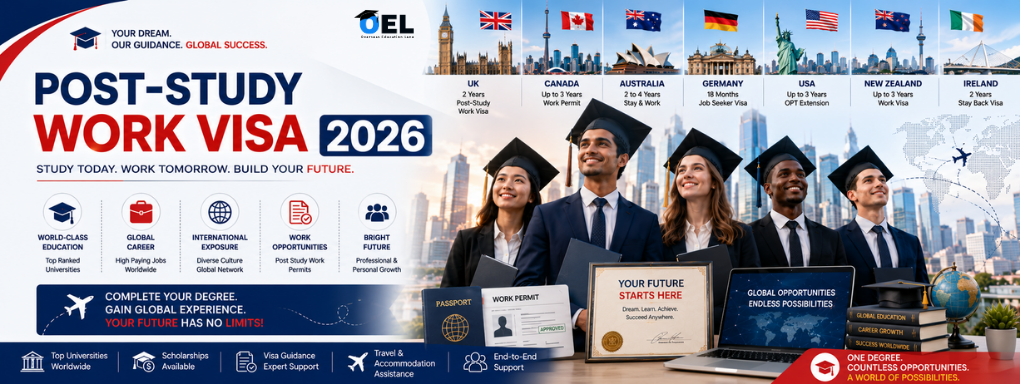
Post-Study Work Visa 2026: Which Countries Let International Students Stay After Graduation?
For many students, choosing a study-abroad destination is no longer only about university rankings, tuition fees, or course quality. Post-study work opportunities have become one of the biggest factors influencing where international students choose to study. Being able to remain in a country after graduation can give students valuable time to gain international work experience, recover part of their education investment, build a professional network, and potentially explore longer-term immigration pathways.
In 2026, countries such as the UK, Canada, Australia, Germany, the USA, and New Zealand continue to offer different forms of post-study work opportunities for international graduates. However, the rules are changing, and the duration of a post-study work visa can depend on your degree level, course duration, field of study, nationality, university, and the date you apply.
For Indian students planning to study abroad in 2026, understanding these rules before choosing a university can make a major difference. A country with a strong post-study work route may offer better opportunities to transition from an international student to a skilled professional.
In this guide, we compare the post-study work visa 2026 options in popular study destinations, explain how long graduates can stay after completing their studies, and discuss what students should consider before choosing a country.
What Is a Post-Study Work Visa?
A post-study work visa is a temporary immigration route that allows eligible international students to remain in a country after successfully completing their studies and work, search for employment, or gain professional experience.
The name and conditions vary by country. For example, the UK uses the Graduate visa, Canada offers the Post-Graduation Work Permit (PGWP), Australia has the Temporary Graduate visa (subclass 485), Germany allows eligible graduates to obtain a residence permit for job searching, and the USA uses Optional Practical Training (OPT) for eligible F-1 students.
These routes are particularly attractive because students do not necessarily have to leave immediately after graduation. Instead, they can use the post-study period to enter the local job market and potentially transition to another work or immigration route.
However, a post-study work visa should not be confused with permanent residency. It is generally temporary, and graduates normally need to meet additional requirements if they want to remain permanently.
Why Post-Study Work Opportunities Matter in 2026
The cost of studying abroad has made return on investment (ROI) an increasingly important consideration for international students. Tuition fees, accommodation, living expenses, travel, health insurance, and other costs can make overseas education a significant investment.
The opportunity to work after graduation can help students gain international professional experience and improve their career prospects. It can also provide time to find an employer that may offer a longer-term work visa or sponsorship where such pathways are available.
For Indian students, post-study work opportunities can be particularly relevant when comparing destinations such as the UK, Canada, Australia, Germany, the USA, Ireland, and New Zealand.
However, students should look beyond the headline duration of a visa. Graduate employment rates, demand for your profession, salary levels, immigration rules, cost of living, and long-term work visa options can be equally important.
UK Post-Study Work Visa 2026
The UK's Graduate visa is one of the most searched post-study work options among international students. It allows eligible students who have successfully completed an eligible UK course to stay in the country and work or look for work without requiring sponsorship under the Graduate route.
There is an important change for students planning their UK study journey in 2026. If you apply for the Graduate visa on or before 31 December 2026, the visa lasts for 2 years. For applications made on or after 1 January 2027, the duration for most bachelor's and master's graduates will be reduced to 18 months. PhD and other doctoral graduates will continue to receive 3 years.
This change makes timing particularly important for students planning a UK Master's in 2026. Students should not assume that starting a course in 2026 automatically guarantees a two-year Graduate visa. The application date determines whether the 2-year or 18-month duration applies.
The Graduate visa cannot be extended, but eligible graduates may be able to switch to another immigration route, such as the Skilled Worker visa, if they meet the relevant requirements.
Canada Post-Study Work Visa 2026
Canada's Post-Graduation Work Permit (PGWP) remains an important pathway for international students who want to gain Canadian work experience after graduation.
The PGWP allows eligible graduates of participating Designated Learning Institutions (DLIs) to work in Canada after completing their studies. However, graduating from a DLI does not automatically mean that every student qualifies for a PGWP. Students need to check whether their particular programme meets the current eligibility requirements.
The duration of a PGWP depends on factors such as the level and duration of the study programme and the validity of the student's passport. Current Canadian rules also include specific language and, for certain programmes, field-of-study requirements.
Eligible graduates generally have up to 180 days after graduation to apply for the PGWP.
Canada's post-study work route is attractive because Canadian work experience can potentially support future permanent-residence applications through eligible immigration pathways. However, a PGWP itself does not guarantee permanent residency, and students should evaluate the latest immigration requirements before making long-term plans.
Australia Post-Study Work Visa 2026
Australia offers the Temporary Graduate visa (subclass 485) for eligible international students who have recently completed an Australian qualification.
Under the current Post-Higher Education Work stream, graduates can generally stay for between 2 and 3 years, depending on their qualification. Bachelor's and coursework Master's graduates generally receive 2 years, while research Master's and doctoral graduates can receive longer periods.
For Indian nationals, Australia has specific arrangements under the Australia-India Economic Cooperation and Trade Agreement (AI-ECTA). Under the current rules, eligible Indian graduates may receive longer periods than the standard duration for certain qualifications. For example, the current official rules list 3 years for Master's degrees and 4 years for doctoral degrees for eligible Indian nationals.
Australia's post-study work route can therefore be particularly attractive for Indian students considering Master's and PhD programmes.
Students should also consider the cost of living, graduate employment opportunities, occupation demand, and potential pathways to longer-term skilled migration when evaluating Australia.
Germany Post-Study Work Opportunities 2026
Germany is another major destination for students looking for a combination of high-quality education, strong research opportunities, and post-study employment options.
International graduates from German universities can generally apply for a residence permit for up to 18 months to look for qualified employment after completing their studies. During this period, graduates can focus on finding employment that matches their academic qualifications.
Germany can be particularly attractive for graduates in fields such as engineering, computer science, artificial intelligence, data science, automotive technology, renewable energy, and other STEM areas, where the country has a large industrial and research ecosystem.
The German post-study route is different from countries such as Canada or Australia because it is primarily structured around finding qualified employment after graduation. Once graduates secure an appropriate job, they may be able to transition to another residence or work route depending on their circumstances.
For students looking for affordable study abroad options with strong career opportunities, Germany can therefore be an important country to consider.
USA Post-Study Work Visa 2026
The United States does not have a post-study work visa with exactly the same structure as the UK's Graduate visa or Canada's PGWP. Instead, eligible F-1 international students can generally use Optional Practical Training (OPT) to gain practical work experience related to their field of study.
Standard post-completion OPT can provide up to 12 months of employment authorisation for eligible students. Students who complete qualifying STEM degrees may be eligible for a 24-month STEM OPT extension, potentially providing up to 36 months of OPT in total.
This makes the USA particularly attractive for students studying fields such as computer science, artificial intelligence, engineering, data science, information technology, and other STEM disciplines.
However, students planning to work in the USA after graduation should understand that OPT is not the same as permanent work authorisation. Many graduates who want to continue working in the country need to explore other employment-based immigration options.
The US immigration environment is also evolving, so students should verify current OPT, F-1 and employment rules before making decisions about studying in the USA.
New Zealand Post-Study Work Visa 2026
New Zealand offers a Post Study Work Visa that can allow eligible international graduates to remain and work in the country for up to 3 years, depending on their qualification and study circumstances.
For eligible degree-level qualifications, graduates can have open work rights, allowing them to work in New Zealand while they explore career opportunities. The exact eligibility requirements depend on the qualification and how it was studied.
New Zealand is also introducing changes in 2026. From 16 November 2026, eligibility for the Post Study Work Visa will expand to certain Level 7 Graduate Diploma graduates who also hold a bachelor's degree. A new Short-term Graduate Work Visa will also open for applications from 16 November 2026, providing eligible graduates with up to six months of open work rights.
These changes make New Zealand another country worth considering for students who want to combine international education with post-study employment opportunities.
Ireland Post-Study Work Opportunities
Ireland is increasingly popular among international students, particularly those interested in technology, business, data analytics, pharmaceuticals, finance, and STEM careers.
Eligible international graduates can use Ireland's Third Level Graduate Programme, which allows qualifying students to remain in Ireland after completing their studies to seek employment and apply for an employment permit.
The duration depends on the level of qualification. Higher-level graduates can receive a longer period under the programme, making Ireland an interesting option for students who want to build a career in the European Union.
Ireland's position as a major European technology and business hub also makes post-study employment an important consideration for students comparing Ireland vs UK or Ireland vs Germany.
Students should verify the latest conditions and eligibility requirements before applying because immigration policies can change.
Post-Study Work Visa Comparison 2026
When comparing the most popular study destinations, students should look at both the duration and conditions of the post-study work route.
| Country | Post-Study Work Route | Typical Duration |
|---|---|---|
| UK | Graduate visa | 2 years if applied by 31 Dec 2026; 18 months from 1 Jan 2027 for most graduates; 3 years for PhD |
| Canada | PGWP | Up to 3 years, depending on eligibility and study |
| Australia | Temporary Graduate visa | Generally 2–3 years; longer periods can apply to eligible Indian nationals |
| Germany | Post-study residence permit | Up to 18 months to seek qualified employment |
| USA | OPT / STEM OPT | Up to 12 months; eligible STEM graduates can reach 36 months |
| New Zealand | Post Study Work Visa | Up to 3 years, depending on qualification |
| Ireland | Third Level Graduate Programme | Duration depends on qualification |
The table provides a broad comparison, but students should not choose a country based only on the number of years. Eligibility conditions, course requirements, field of study, employer demand, salary potential, and long-term immigration pathways can significantly change the overall value of a post-study work route.
Which Country Has the Best Post-Study Work Visa in 2026?
There is no single country that is best for every student.
Canada can be attractive for students who want Canadian work experience and may later explore permanent-residence pathways. However, current PGWP eligibility rules are more detailed than they were in the past, so course and institution selection matter.
Australia can be particularly attractive for Indian students because eligible Indian graduates can receive longer post-study work periods under the current Australia-India arrangements.
Germany can be an excellent option for students interested in engineering, technology, research, and other skilled professions, particularly those looking for a European career.
The UK remains attractive because the Graduate route allows eligible graduates to work or look for work without sponsorship, but the reduction from two years to 18 months for applications from January 2027 is an important consideration.
The USA can be especially powerful for STEM graduates because of the potential 36-month OPT period, although the transition to longer-term employment requires careful planning.
New Zealand offers up to three years of post-study work for eligible graduates and is introducing additional graduate work options in November 2026.
Which Countries Are Best for STEM Students After Graduation?
For students studying STEM courses abroad, post-study work opportunities can be especially important because many countries have strong demand for graduates in technology, engineering, data, healthcare, and scientific fields.
The USA offers the possibility of up to 36 months through standard OPT plus the STEM extension for eligible graduates. Australia provides post-study work opportunities that can be longer for eligible Indian Master's and doctoral graduates. Germany has a dedicated period for graduates to search for qualified employment, while Canada provides the PGWP route for eligible graduates.
Students should therefore consider not only the visa duration but also whether their specific STEM degree is aligned with the country's labour-market demand.
Can You Get Permanent Residency After a Post-Study Work Visa?
A post-study work visa does not automatically lead to permanent residency (PR).
However, in several countries, gaining local work experience can help graduates qualify for other immigration pathways if they meet the relevant requirements.
For example, eligible Canadian work experience may support applications under certain permanent-residence programmes. In other countries, graduates may transition from a post-study route to a skilled employment or employer-sponsored visa.
This is why students should think beyond the question, "How long can I stay after graduation?" A better question is "What can I do after my post-study visa expires?"
Understanding the country's long-term immigration structure before selecting a university can help students make a more informed decision.
How to Choose a Country Based on Post-Study Work Opportunities
Students should begin by identifying their career goal rather than choosing a country only because it offers the longest post-study work visa.
If your priority is technology and STEM employment, the USA, Germany, Canada, and Australia may be worth comparing. If you are interested in a European career, Germany, Ireland, and the UK can offer different pathways. If you want a combination of post-study work rights and a smaller, more manageable study destination, New Zealand can also be considered.
Your course matters just as much as your country. A degree in a high-demand field can provide very different employment opportunities compared with a programme with limited local demand.
Students should compare tuition fees + living costs + post-study work duration + job opportunities + average salaries + immigration pathways before making a final decision.
Common Mistakes Students Make When Choosing a Study Destination
One of the biggest mistakes is selecting a country only because it offers a long post-study work visa. A three-year visa is not necessarily more valuable than a shorter visa if employment opportunities in your field are limited.
Another common mistake is relying on outdated visa information. Immigration policies can change quickly, as demonstrated by the UK's upcoming reduction in the Graduate visa duration and New Zealand's new graduate work options in November 2026.
Students also sometimes assume that completing a degree automatically makes them eligible for a post-study work visa. This is not always true. Canada, for example, states that graduating from a designated learning institution does not automatically make a student eligible for the PGWP.
Finally, students should not confuse a post-study work visa with permanent residency. These are separate immigration pathways with their own requirements.
Frequently Asked Questions About Post-Study Work Visa 2026
Which country gives the longest post-study work visa?
There is no single answer because the duration depends on the qualification, nationality, and visa category. New Zealand can offer up to three years, Australia's duration varies by qualification and nationality, and eligible US STEM graduates can receive up to 36 months through OPT and the STEM extension.
Can I stay abroad after completing my Master's?
Yes. Several popular study destinations provide post-study work routes for eligible Master's graduates. However, eligibility, duration, work rights, and application requirements vary by country.
Which country is best for Indian students after graduation?
The best country depends on your course, career goals, budget, preferred industry, and long-term immigration plans. Australia, Canada, Germany, the UK, the USA, New Zealand, and Ireland can all offer different post-study opportunities.
Is post-study work visa the same as PR?
No. A post-study work visa is generally temporary. It may provide time to gain professional experience and potentially qualify for another work or immigration route, but it does not automatically provide permanent residency.
Can I work after studying in Germany?
Eligible international graduates can generally obtain a residence permit for up to 18 months to search for qualified employment after completing their studies in Germany.
How long can I stay in the UK after graduation?
For eligible bachelor's and master's graduates, the UK Graduate visa lasts 2 years for applications made on or before 31 December 2026 and 18 months for applications made on or after 1 January 2027. PhD graduates can receive three years.
How long can I work in Canada after graduation?
Eligible graduates may receive a PGWP for a period determined by their study programme and current eligibility rules, with the permit potentially lasting up to three years.
Final Thoughts
For students planning to study abroad in 2026, post-study work opportunities should be an important part of the decision-making process. Your choice of country can influence not only where you study but also how easily you can transition from student life into an international career.
The UK, Canada, Australia, Germany, USA, New Zealand, and Ireland all provide opportunities for eligible international graduates, but each country follows a different system. Visa duration, qualification requirements, eligible institutions, work rights, job-market demand, and long-term immigration options can vary significantly.
The most important strategy is to choose your course, university, country, and career pathway together. Don't select a destination simply because its post-study work visa lasts longer. Instead, consider whether the country offers strong employment opportunities in your field and whether you have a realistic pathway after your graduate visa expires.
Immigration rules are also changing rapidly in 2026, so students should always verify the latest government requirements before applying for a student visa or making long-term plans.
Get Free Study Abroad Guidance from Overseas Education Lane
Confused about which country offers the best post-study work opportunities for your career? Overseas Education Lane (OEL) can help you compare countries, courses, universities, scholarships, admission requirements, post-study work options, and student visa pathways.
Whether you're planning to study in the UK, Canada, Australia, Germany, USA, New Zealand, or Ireland, our counselors can help you choose a study destination based on your academic profile and career goals.
📞 Phone: +91 892 992 2525
📧 Email: [email protected]
Start planning your study-abroad journey with the right course, university, and post-study career pathway.
Important: Immigration policies and post-study work visa rules can change. Always verify the latest requirements through the relevant government immigration website before making an application or financial decision.
Other Links
Top Destinations
Our Services
Contact Us
-
 Overseas Education Lane
-
 +91 892 992 2525
-
 [email protected]
-
[email protected]