Canada
USA
UK
Australia
Korea
Ireland
New Zealand
Europe
Japan
Tsinghua University was established in 1911, originally under the name “Tsing Hua Imperial College”. The school was renamed "Tsing Hua College" in 1912. The university section was founded in 1925. The name “National Tsing Hua University” was adopted in 1928.
The faculty greatly valued the interaction between Chinese and Western cultures, the sciences and humanities, the ancient and modern. Tsinghua scholars Wang Guowei, Liang Qichao, Chen Yinque and Zhao Yuanren, renowned as the "Four Tutors" in the Institute of Chinese Classics, advocated this belief and had a profound impact on Tsinghua's later development.
China, Beijing, Beijing, 100190
Tsinghua University
fees may vary according to university current structure and policy
Tsinghua University
fees may vary according to university current structure and policy
Tsinghua University
fees may vary according to university current structure and policy
Tsinghua University
fees may vary according to university current structure and policy
Tsinghua University
fees may vary according to university current structure and policy
Tsinghua University
fees may vary according to university current structure and policy
Tsinghua University
fees may vary according to university current structure and policy
Tsinghua University
fees may vary according to university current structure and policy
Tsinghua University
fees may vary according to university current structure and policy
| Ranking | Form | Year | Type |
|---|---|---|---|
| 20 | QS | 2025 | Public |
International Student Apartments of Tsinghua University was established in 2004. It is located in the northeast corner of the campus, close to the northeast gate of the university (Zijing Gate). The on-campus apartments include Zijing Student Apartment Buildings No. 19-23 and Student Apartment Building No.6 (Asian Youth Center). Full-time international students with university status and studying at the main campus are eligible to apply for accommodation in the International Student Apartments of Tsinghua University.
In recent years, the university has been renovating existing apartments year by year to provide on-campus accommodation resources for more international students. Currently, the international student apartments can accommodate more than 2,000 students. The main responsibilities of the apartment include consulting and handling international students' check-in, check-out, and accommodation information registration; managing daily safety and hygiene in the apartment building; organizing student community cultural activities; and working with students to build a safe and warm student community. In addition, the apartment has a work-study team - the International Dormitory Representatives. As a bridge between students and apartments, they assist apartments in carrying out safety and health inspections, cultural construction, and other related matters to improve student accommodation environment and enrich the culture in student apartment buildings. We welcome you to join this passionate and energetic group!
The International Student Apartment provides three types of dormitories: double room (two beds in one room, shared bathroom on each floor), triple room (three beds in one room, shared bathroom on each floor), AB room (independent bedroom and two persons shared bathroom). In-room facilities mainly include air conditioning, Internet, bedding and furniture. Public area facilities mainly include washing machines, dryers, study rooms, light sports spaces, etc.
Students who are eligible to move in shall have legal and valid identity documents that are consistent with the university's admission status when checking in and registering for accommodation information. During their stay, students should abide by Chinese laws and regulations, and abide by the "Administrative Rules on Disciplinary Sanctions for Student Misconduct of Tsinghua University", "Administrative Measures for Accommodation in Student Apartments at Tsinghua University" and other relevant rules and regulations of the university and apartments.
Students looking for great engineering and computer science programs need look no further than Tsinghua University in Beijing, which since 2015 has been ranked as one of the best in the world for both disciplines.
Tsinghua University was established in 1911 in the wake of the anti-colonialist Boxer Rebellion, which saw the US fine China $30m as punishment. In 1909, President Theodore Roosevelt negotiated with Congress a reduction in the sum, with the leftover money earmarked for university scholarships for Chinese students to study in the US. Tsinghua University was established as a preparatory school for the students’ trips abroad.
Today, Tsinghua’s motto of “self-discipline and excellence” has taken it far. Most university rankings place Tsinghua among the best universities in China, and famous alumni include President Xi Jinping himself, who graduated with a degree in chemical engineering in 1979. Tony Blair, Henry Kissinger, and Bill Clinton are among the distinguished guests who have spoken at Tsinghua.
The university is academically organized into 20 schools and 57 departments covering a broad range of subjects, including science, engineering, arts and literature, social sciences, medicine. Xinya College was established in 2014 as the school’s residential liberal arts college as part of a series of reforms to undergraduate education. Unlike other Tsinghua students who must choose a specific major upon enrollment, Xinya students can declare their majors at the end of their freshman year.
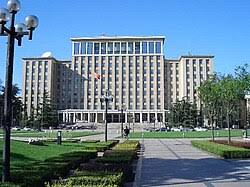
The campus of Tsinghua University is located in northwest Beijing, in the Haidian district, on the former site of the Qing Dynasty royal gardens. As such it retains Chinese-style landscaping as well as traditional buildings, although many of its buildings are also western in style, reflecting its American heritage. Like its archrival Peking, Tsinghua is known for having one of the most beautiful university campuses.
On campus, students keep themselves occupied with more than just academic study (although the heavy workloads mean studying is always a priority). There are more than 110 student clubs and associations covering interests such as science and technology, health and fitness, humanities, arts and public welfare.
Overseas students are particularly encouraged to join in the fun, with a host of extracurricular such as welcome parties, New Year’s parties, graduation parties, and visits to cultural and historical landmarks.
Interactive Overseas Education Lane support assistant. Press Escape to close.
AI Education Advisor