Canada
USA
UK
Australia
Korea
Ireland
New Zealand
Europe
Japan
At Trinity College Dublin, the University of Dublin we provide a liberal environment where independence of thought is highly valued and all are encouraged to achieve their potential. We promote a diverse, interdisciplinary, inclusive environment which nurtures ground-breaking research, innovation, and creativity through engaging with issues of global significance.
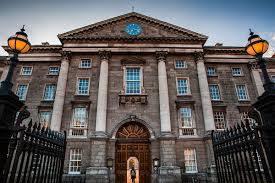
Located in a beautiful campus in the heart of Dublin’s city centre, Trinity is Ireland’s highest ranked university. It is home to 22,000 undergraduate and postgraduate students across all the major disciplines in the arts and humanities, and in business, law, engineering, science, and health sciences.
Trinity’s tradition of independent intellectual inquiry has produced some of the world’s finest, most original minds including the writers Oscar Wilde and Samuel Beckett (Nobel laureate), the scientists William Rowan Hamilton and Ernest Walton (Nobel laureate), the political thinker Edmund Burke, and the former President of Ireland and UNHCR Mary Robinson. This tradition finds expression today in a campus culture of scholarship, innovation, creativity, entrepreneurship and dedication to societal reform.
Ireland, Leinster, Dublin, Dublin 2
Trinity College Dublin
fees may vary according to university current structure and policy
Trinity College Dublin
fees may vary according to university current structure and policy
Trinity College Dublin
fees may vary according to university current structure and policy
Trinity College Dublin
fees may vary according to university current structure and policy
Trinity College Dublin
fees may vary according to university current structure and policy
Trinity College Dublin
fees may vary according to university current structure and policy
Trinity College Dublin
fees may vary according to university current structure and policy
Trinity College Dublin
fees may vary according to university current structure and policy
Trinity College Dublin
fees may vary according to university current structure and policy
Trinity College Dublin
fees may vary according to university current structure and policy
Trinity College Dublin
fees may vary according to university current structure and policy
Trinity College Dublin
fees may vary according to university current structure and policy
Trinity College Dublin
fees may vary according to university current structure and policy
Trinity College Dublin
fees may vary according to university current structure and policy
Trinity College Dublin
fees may vary according to university current structure and policy
Trinity College Dublin
fees may vary according to university current structure and policy
Trinity College Dublin
fees may vary according to university current structure and policy
Trinity College Dublin
fees may vary according to university current structure and policy
Trinity College Dublin
fees may vary according to university current structure and policy
Trinity College Dublin
fees may vary according to university current structure and policy
Trinity College Dublin
fees may vary according to university current structure and policy
Trinity College Dublin
fees may vary according to university current structure and policy
Trinity College Dublin
fees may vary according to university current structure and policy
Trinity College Dublin
fees may vary according to university current structure and policy
Trinity College Dublin
fees may vary according to university current structure and policy
Trinity College Dublin
fees may vary according to university current structure and policy
Trinity College Dublin
fees may vary according to university current structure and policy
Trinity College Dublin
fees may vary according to university current structure and policy
Trinity College Dublin
fees may vary according to university current structure and policy
Trinity College Dublin
fees may vary according to university current structure and policy
Trinity College Dublin
fees may vary according to university current structure and policy
Trinity College Dublin
fees may vary according to university current structure and policy
Trinity College Dublin
fees may vary according to university current structure and policy
Trinity College Dublin
fees may vary according to university current structure and policy
Trinity College Dublin
fees may vary according to university current structure and policy
Trinity College Dublin
fees may vary according to university current structure and policy
Trinity College Dublin
fees may vary according to university current structure and policy
Trinity College Dublin
fees may vary according to university current structure and policy
Trinity College Dublin
fees may vary according to university current structure and policy
Trinity College Dublin
fees may vary according to university current structure and policy
Trinity College Dublin
fees may vary according to university current structure and policy
Trinity College Dublin
fees may vary according to university current structure and policy
Trinity College Dublin
fees may vary according to university current structure and policy
Trinity College Dublin
fees may vary according to university current structure and policy
Trinity College Dublin
fees may vary according to university current structure and policy
Trinity College Dublin
fees may vary according to university current structure and policy
Trinity College Dublin
fees may vary according to university current structure and policy
Trinity College Dublin
fees may vary according to university current structure and policy
Trinity College Dublin
fees may vary according to university current structure and policy
| Ranking | Form | Year | Type |
|---|---|---|---|
| 81 | QS | 2024 | Public |
Trinity has a range of apartments in newly developed, modern buildings across campus. Choose from a wide range of options with up to 8 bedrooms, with private, fully equipped kitchens and living areas.
Our TCPID Business Partners provide us with student work placement and paid graduate internship opportunities.
Our student work placements take place in between February and April each year and are for one morning per week for a period of 8 weeks.
Our graduate internships are usually for 6 months for up to a maximum of 20 hours per week.
From the student / graduate point of view, the work placement / internship experience is of huge benefit in terms of increased independence and self-esteem. The skills developed go far beyond the daily tasks that the person is taught to complete.
From the business partner’s point of view, the experience is also a very rewarding one. The placement / internship allows businesses to work closely with, and mentor a student which then helps their own staff to develop additional skills. The TCPID works closely with the businesses before, during and after the placement to support them throughout.
In the video below, Paula Conradie, Kieran Biddulph and Tomas Murphy, all graduates of the TCPID tell us about their experience with some of the TCPID Business Partners.
Trinity College Dublin was created by royal charter in 1592, at which point Dublin Corporation provided a suitable site, the former Priory of All Hallows. Its foundation came at a time when many universities were being established across western Europe in the belief that they would give prestige to the state in which they were located and that their graduates, clergy for the most part, would perform a vital service as civil administrators. By the 1590s England had two long established universities, each with an expanding group of colleges, and Scotland four. The idea of a university college for Ireland emerged at a time when the English state was strengthening its control over the kingdom and when Dublin was beginning to function as a capital city. The group of citizens, lay and clerical, who were main promoters of the scheme believed that the establishment of a university was an essential step in bringing Ireland into the mainstream of European learning and in strengthening the Protestant Reformation within the country.
The organisational design of the new institution was influenced by Oxford, Cambridge and continental precursors, but from the beginning it was an autonomous corporation governed by ‘provost and fellows’, committed to teaching and to scholarship, the first and (as it turned out) only college of the degree-awarding University of Dublin. The College site, lying some distance east of the small walled city, was far larger than the small community of fellows and students required, and the first brick buildings of the 1590s occupied only a small part of what is now Front Square. But from the beginning the College’s library was a priority, and the energy with which early Trinity scholars (notably Luke Challoner and James Ussher) assembled the initial collections of books marked Trinity out from other sixteenth-century foundations. Many of its early graduates, well grounded in philosophy and theology, proceeded to clerical ordination in the state church, the Anglican Church of Ireland.
During the next fifty years the community grew: endowments, including landed estates, were secured, new fellowships founded, a curriculum devised and statutes determining internal governance were framed. The international reputation of Ussher, one of its first alumni, helped place the College on the European map. But its existence was gravely threatened at two points in the seventeenth century, first when central government collapsed in the wake of the 1641 rising, followed by the temporary eclipse of the Church of Ireland in the wake of Cromwell’s victories; secondly, with the roller-coaster events of 1689-91, when Tyrconnell’s short-lived Catholic government closed the university, expelled the fellows and students, and converted the buildings into a Jacobite barracks. The library however was spared.