
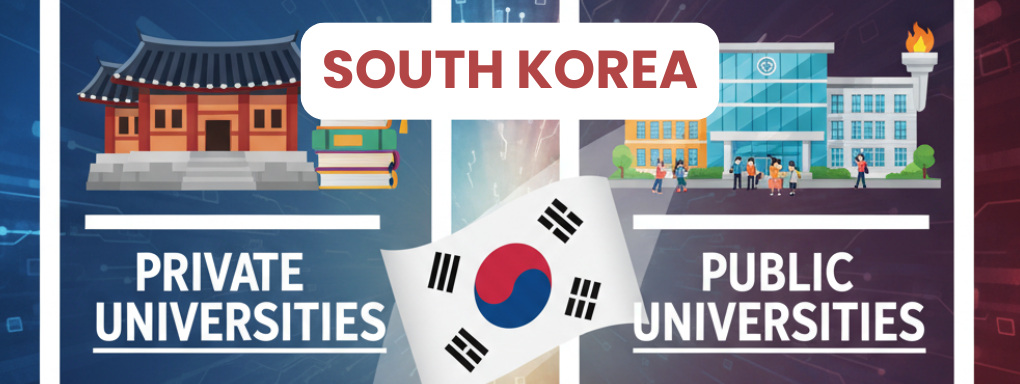
Cost of private vs public universities in South Korea
If you’re an Indian student eyeing an overseas degree and wondering about the cost of studying in South Korea, one of your biggest decisions is choosing cost of private vs public universities in South Korea. The difference in tuition, living expenses, scholarship potential, and campus experience can dramatically affect your budget and future return on investment. In this blog, we unpack these differences, explain why it matters, and provide actionable guidance to help you make an informed choice.
What defines public vs private?
Public universities are state-funded or national institutions. They typically receive government support and have relatively lower tuition.
Private universities are run by private or non-governmental bodies, more dependent on tuition and donations, and often charge higher fees.
Key differences in structure and reputation
Many public institutions in South Korea (for example, those specialising in STEM) have strong research backing, government funding, and are seen as more affordable.
Private universities frequently focus on business, liberal arts, international programmes and have vibrant student life, but the cost is higher.
2. Cost Comparison: Tuition & Living Expenses
Tuition for Indian / international students
Here is a summary table of approximate annual cost ranges:
Type of University | Tuition (Undergraduate) | Notes |
Public universities | ~ KRW 4,000,000 per semester (~US $3,000) | Varies by programme & language of instruction |
Private universities | ~ KRW 6,500,000+ per semester (~US $4,500+) | Higher cost, often for English-taught or specialised programmes |
General range for international students | US $1,500-6,000 per semester (public) and US $3,000-8,000 per semester (private) |
|
Living costs & accommodation
On-campus dorms: KRW 822,000 – KRW 1,161,000/month for single students.
Monthly living (off campus) can run higher depending on city (e.g., Seoul) and lifestyle.
So when comparing Cost of private vs public universities in South Korea, remember to factor living costs alongside tuition.
Example for Indian student
If you pick a public university with tuition ~US $3,000 per year plus living costs US $8,000 per year, your total might be ~US $11,000 (~₹9–10 lakh) per annum. If you pick a private university with tuition ~US $6,000 and similar living costs, budget ~US $14,000–15,000 (~₹12–13 lakh). These are ballpark figures but illustrate the gap.
Scholarship & Funding Opportunities
Scholarships can significantly reduce the cost gap when comparing the cost of private vs public University Tuition Fees.
Key scholarships for Indian/international students
Global Korea Scholarship (GKS) (formerly KGSP): offers full or partial tuition waiver, monthly stipend, airfare for international students in South Korea.
University-specific scholarships: Many private and public universities have merit- or need-based funds for international students.
Government-listed scholarships: As noted by the Indian Embassy in Seoul, undergraduate students may get minimum 30% tuition fee support; graduates may get full tuition fee exemption.
- Checklist for Indian students
- Check if university offers English-taught programmes for international students.
- Confirm scholarship eligibility (GPA, language proficiency, nationality).
- Calculate net cost after scholarship, not just sticker tuition.
- Factor in living cost, visa, travel, health insurance.
Which University Type is More Cost-Effective for Indian Students?
Public universities: The budget-friendly pick
Lower tuition → easier to manage financially.
Strong in STEM/research fields.
Might have fewer campus amenities compared to private.
May have fewer English-taught options (though this is changing).
Private universities: Premium options with higher cost
More English-taught programmes, diverse majors, international student support.
Higher tuition but often stronger brand, networking and campus life.
With scholarships, net cost may become competitive.
Framework to decide
Step 1: Rank your priorities (major, English vs Korean instruction, brand/reputation, cost)
Step 2: Short-list 3 public + 3 private universities.
Step 3: For each, gather: annual tuition, living cost, scholarship options, and net cost for Indian students.
Step 4: Compare ROI — e.g., cost vs job prospects vs global brand value.
Step 5: Make decision based on balance of cost + quality + support for international students.
Tip: For Indian students who are cost-sensitive, a well-chosen public university may offer the best value. If budget allows and you want high support + global network, a private university may be worth the premium.
Do’s & Don’ts
Do’s
Do verify tuition and living cost in Indian Rupees (₹) for realistic budgeting.
Do reach out to university international office for Indian student experiences.
Do check if the programme is English taught (important for Indian students who may not know Korean).
Do apply for scholarships early and submit all required documents on time.
Don’ts
Don’t assume cost at public = very cheap; living cost in big cities like Seoul can add up.
Don’t ignore language requirements — even English programmes may require some Korean proficiency.
Don’t pick a university only based on low tuition; check quality, support services and job prospects.
FAQs
Q1. Is it cheaper to study at a public university in South Korea?
Yes – generally public universities have lower tuition than private ones, meaning lower overall cost.
Q2. Can Indian students get scholarships at Korean private universities?
Yes – many private and public universities offer scholarships to international students, including Indian nationals. See institutional websites and national programmes.
Q3. What is the approximate living cost in South Korea?
Monthly living costs can vary widely; on-campus dorms have one set of numbers (~KRW 822,000–1,161,000/month) and off-campus often more.
Choosing between cost of public vs private universities in South Korea is more than just comparing tuition numbers—it’s about understanding how cost, quality, scholarship support and your personal career goals align. For Indian students, the right choice can offer a top-tier global education without breaking the bank.
At Overseas Education Lane (OEL), we help Indian students evaluate cost, scholarships, programme fit and assist with application & visa process to South Korean universities. Contact us today to explore your best options, compare affordable universities, and secure your place for the upcoming intake. Your global study journey starts here.
Other Links
Top Destinations
Our Services
Contact Us
-
 Overseas Education Lane
-
 +91 892 992 2525
-
 [email protected]
-
[email protected]